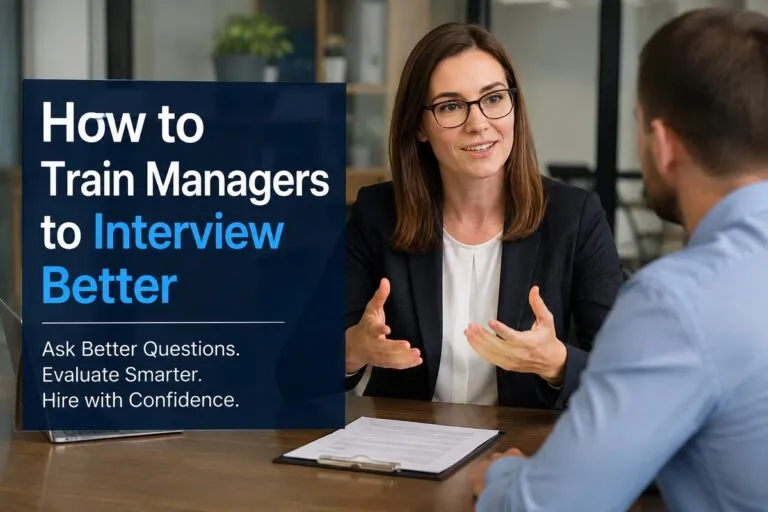
How to Train Managers to Interview Better
How to train managers to interview better starts with giving them a consistent process for evaluating candidates, asking effective interview questions, and making hiring decisions based on evidence rather than instinct. Managers may understand the technical requirements of a position extremely well, but that does not automatically make them effective interviewers.
For employers hiring specialized professionals such as CAD designers, drafters, IT support specialists, help desk technicians, and other technical employees, interview quality can have a major impact on hiring outcomes. A poorly structured interview can overlook a strong candidate or create enthusiasm for someone whose experience does not actually match the position.
Interview training should give hiring managers practical techniques they can apply immediately. The goal is to help managers identify job-related competencies, ask questions that produce useful information, evaluate answers consistently, and give qualified candidates a professional interview experience.
Build a Consistent Interview Process
One of the first steps in training managers to interview better is establishing a repeatable interview structure.
Without a defined process, managers can easily conduct completely different interviews for candidates applying for the same position. One candidate may receive detailed technical questions while another spends most of the interview discussing personality and previous employers.
A structured interview creates a more useful comparison.
Hiring managers should understand what needs to be evaluated before the first candidate enters the interview. HR and recruiting teams can help managers identify the most important competencies and create questions around them.
A basic interview structure might include:
- A brief introduction to the position and interview format
- Questions about relevant work experience
- Behavioral interview questions
- Role-specific or technical questions
- Situational questions based on realistic workplace scenarios
- Time for candidate questions
- A consistent evaluation process after the interview
Managers do not need to follow a rigid script word for word. However, every candidate should be evaluated against the same core job requirements.
Train Managers to Interview Against the Job Requirements
Managers should enter an interview knowing exactly what they need to learn about the candidate.
A long job description can contain dozens of responsibilities, qualifications, and preferred skills. Not all of those requirements deserve equal attention during an interview.
Before interviewing candidates, identify the competencies that are most important to successful performance.
For a CAD position, those competencies might include proficiency with specific design software, experience interpreting technical drawings, revision management, accuracy, and collaboration with engineers or project managers.
For an IT support position, the interview may focus on troubleshooting ability, ticket management, operating systems, networking fundamentals, customer communication, escalation procedures, and documentation.
Managers can then build interview questions around these requirements instead of asking whatever comes to mind during the conversation.
Separate Required Skills From Preferred Skills
Interviewers should understand the difference between qualifications a candidate genuinely needs and qualifications that would simply be useful.
If every preferred qualification is treated as mandatory, managers may reject candidates who could perform the job successfully.
Before interviews begin, classify requirements into categories such as:
- Essential technical skills
- Essential workplace competencies
- Preferred technical experience
- Trainable skills
- Experience that would be helpful but is not necessary
This gives hiring managers a clearer framework for evaluating candidates and prevents less important qualifications from receiving too much weight.
Teach Managers How to Ask Better Interview Questions
Effective interview questions encourage candidates to provide specific information about their experience, decisions, and results.
Broad questions often produce broad answers. Managers should learn to ask questions that require candidates to describe actual situations whenever possible.
Instead of asking, “Are you good at troubleshooting?” an interviewer could ask:
“Tell me about a difficult technical issue you diagnosed. What information did you gather, what steps did you take, and what was the outcome?”
Instead of asking a CAD candidate, “Are you detail-oriented?” the manager might ask:
“Tell me about a time you discovered an error or inconsistency in a drawing before it reached the next stage of a project. How did you identify it and what did you do?”
These questions provide evidence that managers can evaluate.
Use Behavioral Interview Questions Effectively
Behavioral interview questions are particularly useful when managers need to evaluate how someone has handled situations relevant to the open position.
Train managers to ask questions about specific examples rather than accepting general statements about how candidates usually behave.
Useful areas for behavioral interview questions include:
- Managing competing priorities
- Handling difficult customers or internal users
- Finding and correcting mistakes
- Meeting deadlines
- Resolving technical problems
- Working with other departments
- Receiving feedback
- Explaining technical information
- Handling unexpected project changes
The strongest follow-up questions are often simple: “What did you do?” “Why did you choose that approach?” and “What was the result?”
Follow-up questions can reveal significantly more than moving immediately to the next prepared question.
Improve Technical Interviewing Skills
Technical managers sometimes assume that technical interviews should be difficult. Difficulty, however, is not the same as relevance.
A technical interview should determine whether a candidate can perform the responsibilities associated with the actual job.
Interview training should encourage managers to focus technical questions on realistic work rather than obscure knowledge that employees rarely need.
Use Realistic Job Scenarios
Scenario-based interview questions can be especially valuable for CAD and IT support hiring because candidates can demonstrate how they approach a problem.
An IT support manager might describe a user who suddenly cannot access a network resource and ask the candidate to explain the troubleshooting process.
The manager can evaluate whether the candidate gathers information, checks likely causes systematically, communicates appropriately with the user, documents the issue, and understands when escalation is necessary.
A CAD hiring manager could provide a scenario involving conflicting drawing information, an unexpected revision, or a tight deadline and ask how the candidate would proceed.
The objective is not necessarily to hear one perfect answer. Managers should listen for the candidate’s reasoning, technical judgment, and ability to identify important information.
Avoid Turning Interviews Into Trivia Tests
Interview questions should have a clear relationship to job performance.
Highly specific trivia can eliminate qualified candidates simply because they cannot recall a fact under interview conditions. In many technical jobs, knowing how to investigate and solve a problem is more valuable than memorizing every possible command, specification, or error code.
Managers should ask themselves a simple question before using a technical interview question: Does the answer help us determine whether this person can perform the job?
If the answer is no, the question probably does not belong in the interview.
Train Managers to Listen Instead of Selling the Position Too Early
Managers often spend too much of an interview talking.
They may describe the department, projects, technology, company history, team structure, and position in detail before learning enough about the candidate.
Managers should certainly provide candidates with useful information, but the interview needs enough time for meaningful evaluation.
Teach interviewers to ask a question, listen carefully, take concise notes, and use follow-up questions when additional detail is needed.
If a candidate gives a vague answer, the manager should not fill in the missing information for them. Ask for clarification.
Questions such as “Can you give me a specific example?” or “What part of that project were you personally responsible for?” can help distinguish direct experience from general familiarity.
Reduce Interview Bias With Defined Evaluation Criteria
Interview bias can influence hiring decisions even when interviewers have good intentions.
Managers may naturally respond more positively to candidates who communicate similarly to them, attended familiar schools, worked for recognizable companies, or share common interests.
Interview training should help managers distinguish between personal impressions and job-related evidence.
A candidate being easy to talk to does not necessarily mean that person is the strongest candidate. Likewise, a candidate who is somewhat nervous during an interview may still have excellent technical skills and job performance.
Replace “Gut Feeling” With Evidence
Managers sometimes describe candidates by saying, “I just liked them,” “They seemed sharp,” or “I don’t think they would fit.”
These statements provide little information for making a defensible hiring decision.
Train managers to explain their evaluations using specific evidence from the interview.
Instead of saying, “She seems great with customers,” an interviewer could document:
“She described handling an escalated support ticket involving an upset user, explained how she communicated the troubleshooting process, and provided a specific example of resolving the issue without further escalation.”
That is evidence the hiring team can discuss.
Create an Interview Scorecard
An interview scorecard gives managers a consistent way to evaluate candidates after each conversation.
The scorecard should be tied directly to the competencies required for the position. Avoid overly complicated scoring systems that managers are unlikely to use consistently.
For example, an IT support interview scorecard could evaluate:
- Troubleshooting methodology
- Technical knowledge
- Customer communication
- Ticket documentation
- Prioritization
- Escalation judgment
- Relevant systems experience
A CAD interview scorecard might evaluate:
- CAD software proficiency
- Drawing accuracy
- Technical drawing knowledge
- Revision control
- Relevant industry experience
- Problem-solving
- Collaboration and communication
Define what strong, acceptable, and weak evidence looks like for important categories. This gives interviewers a common reference point when discussing candidates.
Require Managers to Take Useful Interview Notes
Interview notes should capture job-related evidence, not personal judgments.
Managers should document specific examples, relevant technical experience, candidate responses, and any areas requiring additional verification.
Good interview notes make candidate comparisons easier, particularly when several interviews take place over multiple days.
Notes also reduce the tendency to remember only the most recent candidate or the candidate who made the strongest personal impression.
Train managers to avoid notes about protected characteristics or unrelated personal details. Documentation should remain focused on information relevant to the hiring decision.
Teach Managers Which Interview Questions to Avoid
Interview training should include clear guidance about inappropriate questions.
Managers may unintentionally move into sensitive areas during casual conversation, particularly when trying to build rapport.
Interviewers should avoid questions about subjects such as age, religion, disability, family or marital status, pregnancy, and other protected characteristics. HR teams should provide managers with guidance appropriate to the laws and regulations that apply to their organization and location.
Managers should also learn how to redirect conversations when candidates voluntarily mention personal information.
The safest approach is usually to return the discussion to job-related qualifications and requirements.
Practice Interviewing Before Managers Interview Candidates
Interviewing improves through practice.
Managers can participate in mock interviews with HR, recruiters, or other managers before conducting candidate interviews. This is particularly helpful for first-time hiring managers.
During a mock interview, evaluate whether the manager:
- Explains the interview clearly
- Asks concise questions
- Allows the candidate enough time to answer
- Uses appropriate follow-up questions
- Avoids leading questions
- Takes useful notes
- Covers the required competencies
- Avoids inappropriate questions
- Keeps the conversation on schedule
Afterward, provide specific feedback based on observable interviewing behavior.
For example, telling a manager to “ask better questions” is vague. Telling the manager that three questions encouraged yes-or-no responses and then rewriting those questions together gives the manager something practical to improve.
Calibrate Interviewers Before Hiring Begins
When several people are interviewing candidates, they should agree on what they are evaluating before interviews begin.
Otherwise, each interviewer may develop a different definition of the ideal candidate.
An HR professional, recruiter, or hiring leader can conduct a short interview calibration meeting before the first interview. Review the job requirements, discuss the interview questions, assign competencies to individual interviewers, and establish how candidates will be scored.
Calibration is especially useful when technical and nontechnical interviewers participate in the same hiring process.
For example, a technical manager may evaluate CAD software expertise while another interviewer focuses on project communication and collaboration. An IT manager may evaluate troubleshooting skills while HR focuses on broader employment requirements and communication.
This reduces unnecessary duplication and gives the hiring team a more complete candidate assessment.
Improve the Interview Debrief Process
Interview training should continue through the candidate evaluation stage.
If the post-interview discussion begins with the most senior manager announcing, “I loved this candidate,” other interviewers may be influenced before sharing their own assessments.
A stronger process is for each interviewer to complete the interview scorecard independently before the hiring team discusses the candidate.
During the debrief, ask interviewers to support ratings with specific evidence.
If two interviewers disagree, determine what information led to the difference. One interviewer may have received an example that another did not, or they may be applying different standards.
The purpose of the debrief is not to reach agreement as quickly as possible. It is to determine whether the available evidence supports moving the candidate forward.
Give Managers Feedback on Their Interviewing
Managers need feedback on interviewing just as they do on other management responsibilities.
HR and recruiting teams can identify patterns in the hiring process that suggest additional coaching is needed.
For example, a manager may consistently reject candidates who recruiters consider well qualified. Another manager may recommend nearly everyone they interview. Some managers may frequently run over the scheduled interview time or fail to complete scorecards.
Candidate feedback can also reveal problems with the interview process. Repeated reports of unclear expectations, disorganized interviews, excessive delays, or irrelevant questioning deserve attention.
Use these patterns to provide targeted interview coaching rather than relying exclusively on generic training sessions.
Measure Whether Interview Training Is Improving Hiring
Organizations should determine whether manager interview training is producing better hiring decisions.
The goal is not simply to confirm that managers completed a training session. The goal is to improve interview consistency and hiring quality.
Useful recruiting and hiring metrics can include:
- Interview-to-offer ratio
- Offer acceptance rate
- Time to fill
- Candidate experience feedback
- New-hire retention
- Hiring manager satisfaction
- Completion of interview scorecards
- Quality of interview feedback
- Performance of new hires after placement
Metrics should be interpreted carefully. No single number proves that an interviewer is effective or ineffective, but patterns can reveal where the interview process needs attention.
Make Interview Training Specific to the Positions Being Filled
Generic interviewer training has value, but managers also need preparation that reflects the positions they actually hire.
A manager interviewing an IT support specialist needs different technical evaluation criteria than someone hiring a CAD designer. Even positions within the same field can require different interview approaches.
For example, an entry-level help desk role may place greater emphasis on communication, troubleshooting fundamentals, and learning ability. A senior IT support position may require deeper experience with infrastructure, escalations, security practices, and complex troubleshooting.
Similarly, a CAD drafter and a senior CAD designer may use some of the same software while requiring very different levels of technical judgment, design responsibility, and project experience.
Before opening a position, recruiters, HR professionals, and hiring managers should establish what successful performance actually requires and build the interview around those requirements.
Better manager interviews come from preparation, structure, relevant questions, consistent evaluation, and evidence-based hiring decisions. When managers know exactly what competencies they are assessing and how to evaluate candidate responses, interviews become more useful for both the employer and the candidate.
For organizations hiring CAD and IT support professionals, that discipline is particularly valuable. Specialized candidates may have similar job titles while possessing very different levels of hands-on experience. A well-trained interviewer can identify those differences, evaluate candidates against the actual requirements of the position, and make stronger direct-hire decisions.
Content reviewed and published by Tier2Tek Staffing Editorial Team.