IT Support Staffing in Sacramento for Business Continuity

Sacramento businesses rely on stable IT support to keep employees productive, protect business operations, and maintain customer service. Whether supporting healthcare organizations, government contractors, financial institutions, logistics providers, manufacturers, or professional service firms, IT support teams often serve as the first line of defense against operational disruptions. A single unfilled support position can create delays that ripple across an entire organization, increasing ticket backlogs, reducing employee productivity, and placing additional pressure on senior IT staff.
Tier2Tek Staffing helps Sacramento employers build dependable IT support teams by identifying professionals who can operate effectively in business-critical environments. Our recruiting process focuses on technical capability, communication skills, business maturity, and the ability to perform within structured support environments. Employers benefit from access to qualified candidates who can integrate quickly into existing IT operations while minimizing hiring risk.
Understanding Sacramento’s IT Support Hiring Environment

Sacramento presents a unique technology hiring market. While Silicon Valley often attracts engineering talent, Sacramento has developed a stable demand for IT support professionals serving state government agencies, healthcare systems, education, financial services, utilities, and regional corporate headquarters. These employers frequently compete for the same experienced support professionals.
Unlike larger technology hubs where software engineering dominates hiring, Sacramento organizations often prioritize operational stability. Employers need technicians capable of supporting hundreds or thousands of end users, maintaining uptime, resolving incidents efficiently, and working within structured ITIL-based service environments.
Another characteristic of Sacramento’s market is the significant presence of organizations operating under regulatory frameworks. Government contractors, healthcare providers, insurance organizations, and public sector entities frequently require support professionals who understand documentation standards, security procedures, and compliance expectations. Technical skills alone rarely determine hiring success.
Many regional employers also maintain multiple satellite offices throughout Northern California. As a result, IT support professionals are frequently expected to provide a combination of onsite assistance, remote troubleshooting, and occasional travel between facilities.
Why IT Support Vacancies Create Operational Risk

Business leaders often underestimate how quickly staffing shortages affect day-to-day operations.
When service desk queues grow beyond acceptable response times, employees begin losing productive hours waiting for password resets, workstation repairs, VPN connectivity, printer issues, software installations, and application support.
Operational impacts commonly include:
- Increased ticket resolution times
- Employee downtime
- Delayed onboarding for new hires
- Security risks from unresolved endpoint issues
- Burnout among existing IT personnel
- Escalation of routine issues to senior engineers
- Lower employee satisfaction with internal IT services
Support organizations frequently operate using established service level agreements. Missing staffing targets can jeopardize internal performance metrics while reducing confidence from business stakeholders who depend on responsive technology support.
In Sacramento’s healthcare and public sector environments, prolonged support delays may also affect departments operating under strict compliance requirements where system availability directly influences service delivery.
Local Hiring Bottlenecks Businesses Commonly Encounter
Sacramento employers often experience hiring challenges that differ from larger metropolitan technology markets.
One common bottleneck involves experienced Tier 2 support professionals. Many organizations seek technicians capable of handling Active Directory administration, Microsoft 365 troubleshooting, Azure administration, endpoint management, and networking fundamentals. Candidates possessing this combination of experience frequently receive multiple offers.
Another challenge involves security awareness. Organizations increasingly expect help desk personnel to recognize phishing attempts, enforce multi-factor authentication, follow endpoint security procedures, and escalate cybersecurity incidents appropriately.
Many employers also compete with government agencies that offer stable employment and attractive retirement benefits. While private employers may provide stronger career growth opportunities, recruiting timelines frequently extend when organizations rely on traditional hiring processes.
Lengthy interview cycles often cause qualified candidates to accept competing offers before decisions are finalized.
Operational Consequences of Slow IT Support Hiring
Hiring delays affect more than recruitment metrics.
| Operational Area | Business Impact |
|---|---|
| Employee onboarding | Delayed workstation deployment and account provisioning |
| Help desk operations | Growing ticket backlog and slower response times |
| Infrastructure support | Preventive maintenance postponed |
| Cybersecurity | Increased exposure from unresolved endpoint vulnerabilities |
| IT leadership | More time spent covering operational work instead of strategic initiatives |
| Employee productivity | Lost work hours waiting for technical assistance |
Many organizations initially redistribute work among existing technicians. While manageable during short periods, extended staffing shortages typically increase turnover among experienced personnel due to sustained workload pressure.
Replacing one vacancy can become multiple vacancies if burnout is ignored.
Supporting Today’s Hybrid Workforce
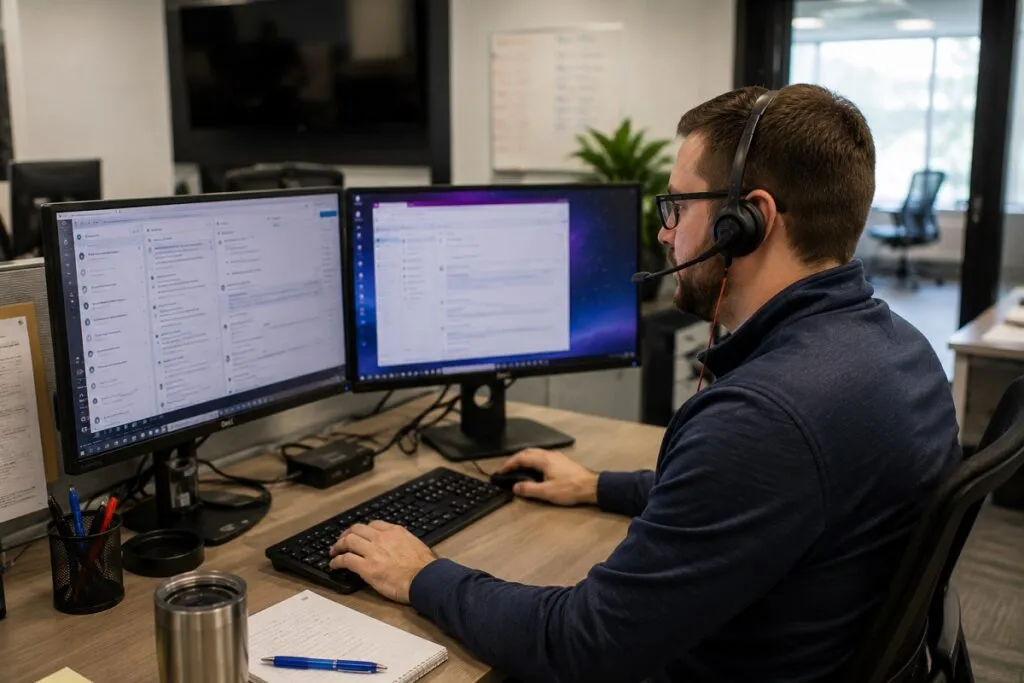
Hybrid work has permanently changed employer expectations for IT support professionals.
Modern support teams must assist users across corporate offices, home offices, remote locations, and mobile environments while maintaining consistent service quality.
Employers increasingly expect candidates to demonstrate experience supporting:
- Microsoft 365
- Azure Active Directory
- Intune
- VPN technologies
- Remote desktop platforms
- Endpoint management
- Microsoft Teams
- Zoom
- Cisco collaboration tools
- Multi-factor authentication
- Cloud identity management
Remote troubleshooting also requires stronger communication skills. Successful technicians can guide non-technical employees through complex troubleshooting steps without creating additional frustration.
These soft skills often distinguish high-performing support professionals from technically capable candidates who struggle in customer-facing environments.
Business Leaders Must Balance Speed with Hiring Quality
Organizations under staffing pressure sometimes prioritize immediate availability over long-term fit.
This approach often creates hidden costs.
Candidates lacking experience within structured IT environments frequently require longer onboarding periods, create inconsistent documentation, or struggle with escalation procedures.
Business leaders must evaluate several competing priorities:
| Hiring Priority | Operational Tradeoff |
|---|---|
| Hire immediately | Faster coverage but higher performance risk |
| Wait for ideal candidate | Longer operational strain but stronger long-term stability |
| Upskill junior staff | Lower salary but extended training timeline |
| Add contract resources | Immediate flexibility with less organizational continuity |
Effective staffing decisions require balancing immediate operational needs with future scalability.
Common Hiring Mistakes Sacramento Employers Make
Several patterns repeatedly appear during IT support recruiting engagements.
Organizations frequently write job descriptions combining help desk, systems administration, cybersecurity, networking, desktop engineering, cloud administration, and project management into a single position.
This narrows candidate pools dramatically.
Another mistake involves focusing almost exclusively on certifications while overlooking demonstrated troubleshooting experience.
Certifications validate knowledge but do not necessarily predict performance in high-volume support environments.
Some employers also underestimate the importance of communication ability. Technical support professionals interact with executives, department managers, healthcare staff, finance teams, and external vendors. Strong interpersonal skills often determine employee satisfaction more than purely technical expertise.
Finally, extended interview processes continue eliminating qualified candidates from consideration. Sacramento’s strongest IT support professionals rarely remain available for multiple weeks.
How Tier2Tek Evaluates IT Support Candidates

Tier2Tek Staffing evaluates candidates beyond technical keywords listed on resumes.
Our recruiting process considers how candidates perform within real operational environments.
Areas evaluated include:
- Troubleshooting methodology
- Customer service communication
- Windows administration experience
- Microsoft 365 administration
- Active Directory management
- Ticketing system experience
- Remote support capabilities
- Documentation quality
- Escalation judgment
- Technical adaptability
- Professionalism under pressure
We also assess employment stability, technical progression, certifications, business communication, and the types of support environments candidates have previously worked within.
Rather than matching resumes to job descriptions, we evaluate how individuals contribute to operational continuity inside active IT departments.
For employers seeking broader support staffing expertise, visit our IT Support Staffing page.
Scalability Matters More Than Filling One Position
Many organizations begin recruiting after service levels have already declined.
However, effective workforce planning considers future demand rather than current vacancies.
Business expansion, acquisitions, seasonal hiring, office relocations, software implementations, and infrastructure upgrades often generate rapid increases in support ticket volume.
Organizations with scalable staffing strategies can respond without overwhelming internal IT teams.
Tier2Tek supports both individual placements and higher-volume hiring initiatives when organizations need to expand support operations quickly.
Qualified candidates are typically available within 1 to 3 days for many common IT support roles.
Technology Platforms Commonly Found Across Sacramento Employers
Experienced support professionals frequently encounter diverse technology environments.
Regional employers commonly utilize:
- Microsoft 365
- Windows 11
- Active Directory
- Azure
- VMware
- Cisco networking
- ServiceNow
- Jira Service Management
- ConnectWise
- Freshservice
- Zendesk
- Intune
- SCCM
- Okta
- Entra ID
- PowerShell
- VMware Horizon
- Citrix
Candidates who understand multiple enterprise platforms generally transition into new environments more efficiently than specialists with experience supporting only one ecosystem.
Why Business Continuity Depends on Strong IT Support Staffing
Business continuity planning often emphasizes cybersecurity, disaster recovery, and infrastructure redundancy.
Yet many continuity failures originate from insufficient staffing.
Technology incidents still require skilled personnel capable of restoring systems, communicating with users, documenting actions, escalating appropriately, and coordinating with infrastructure teams.
Without adequate staffing, even resilient technology environments experience longer recovery times.
Support personnel represent a critical operational layer connecting employees with business systems.
Organizations investing in reliable staffing frequently reduce operational disruption while improving employee satisfaction and maintaining stronger internal service levels.
Tier2Tek’s Recruiting Standards
Tier2Tek Staffing combines technical recruiting expertise with ongoing market research to evaluate changing hiring conditions across the IT support landscape.
Our recruiting methodology emphasizes operational fit, technical competency, communication ability, and long-term hiring success rather than resume matching alone. Candidate evaluations are informed by current enterprise technology environments, employer hiring expectations, and practical experience recruiting IT professionals across a wide range of business sectors.
This commitment to consistent evaluation standards helps employers make informed staffing decisions with greater confidence.
Frequently Asked Questions
Qualified candidates are often available within 1 to 3 business days depending on the position and technical requirements.
Yes. We regularly support employers that need multiple IT support professionals for office expansions, technology rollouts, mergers, and large operational initiatives.
Candidates commonly possess experience supporting Microsoft environments, Active Directory, Microsoft 365, enterprise ticketing systems, remote users, endpoint management, and business-critical applications.
Yes. We recruit professionals for onsite, hybrid, and remote support environments throughout the Sacramento region.
We recruit IT support professionals for healthcare, government contractors, financial services, manufacturing, logistics, education, professional services, and many other industries.
We assess troubleshooting methodology, technical knowledge, communication ability, customer service skills, documentation quality, employment history, and experience operating within enterprise IT environments.