
IT support hiring for enterprise companies requires a structured, strategic approach that aligns technical expertise with business continuity, security, and scalability. Large organizations operate complex infrastructures, making the hiring process far more nuanced than simply filling help desk roles. Hiring managers and HR teams must focus on identifying candidates who can operate within layered systems, handle high ticket volumes, and support mission critical environments without disruption.
Enterprise IT support teams are often the backbone of internal productivity. A weak hire can slow down operations, while a strong one can improve efficiency across departments. This makes recruitment decisions especially impactful at scale.
Understanding Enterprise-Level Hiring Needs
Enterprise environments demand more than general IT support skills. Candidates must be comfortable navigating multi-tiered systems, enterprise software, and strict compliance frameworks.
Key characteristics to prioritize
- Experience with enterprise ITSM platforms such as ServiceNow or Jira Service Management
- Familiarity with large-scale network environments and cloud infrastructure
- Ability to manage high-volume ticket queues with prioritization skills
- Knowledge of security protocols and compliance standards
- Strong documentation and communication practices
Hiring for enterprise IT support also means evaluating how well candidates can work within structured workflows. Unlike smaller organizations, enterprises rely heavily on processes, escalation paths, and service-level agreements.
Defining Roles Clearly Before Hiring

A common issue in IT support recruitment is vague job descriptions. Enterprise companies benefit from clearly segmented roles to avoid overlap and inefficiency.
Typical enterprise IT support roles
Tier 1 Support Specialists
Handle initial troubleshooting, password resets, and basic technical issues. These roles require strong customer service skills and the ability to triage efficiently.
Tier 2 Support Engineers
Address more complex issues involving systems, applications, and configurations. Candidates should have deeper technical knowledge and problem-solving capabilities.
Tier 3 or Escalation Engineers
Focus on advanced troubleshooting, root cause analysis, and infrastructure-level problems. These roles often require specialization in areas such as networking, cloud, or cybersecurity.
Why role clarity matters
- Reduces time-to-hire by targeting the right candidates
- Improves onboarding efficiency
- Minimizes internal confusion and ticket mismanagement
- Supports better performance tracking
Building an Effective IT Support Hiring Strategy

Enterprise hiring requires a repeatable and scalable recruitment strategy. Ad hoc hiring often leads to inconsistent results.
Core elements of a strong hiring strategy
Standardized technical assessments
Use role-specific tests to evaluate real-world problem-solving skills rather than relying solely on resumes.
Structured interview processes
Create consistent interview frameworks to compare candidates objectively. Include both technical and behavioral evaluations.
Collaboration between HR and IT leadership
Ensure hiring managers and HR teams align on expectations, salary benchmarks, and required skill sets.
Talent pipeline development
Maintain a pool of pre-qualified candidates for faster hiring during peak demand periods.
Key Skills to Evaluate in Candidates
Hiring managers should look beyond certifications and focus on practical capabilities that impact enterprise environments.
Technical skills
- Operating system expertise across Windows, macOS, and Linux
- Active Directory and identity management experience
- Networking fundamentals including DNS, DHCP, and VPNs
- Cloud platform familiarity such as AWS or Azure
- Endpoint management tools and remote support systems
Soft skills
- Clear communication with both technical and non-technical users
- Ability to remain calm under pressure
- Strong documentation habits
- Time management and prioritization
Red flags to watch for
- Over-reliance on scripted solutions
- Lack of troubleshooting methodology
- Poor communication during technical explanations
Leveraging Technology in the Hiring Process
Enterprise companies can streamline IT support hiring using recruitment technology and automation tools.
Tools and techniques
- Applicant tracking systems for managing large candidate pools
- AI-driven resume screening to identify relevant experience
- Skills assessment platforms for technical validation
- Video interview tools for remote hiring scalability
These tools help reduce manual workload while improving candidate quality. However, they should support decision-making rather than replace human evaluation.
Optimizing Job Descriptions for SEO and Talent
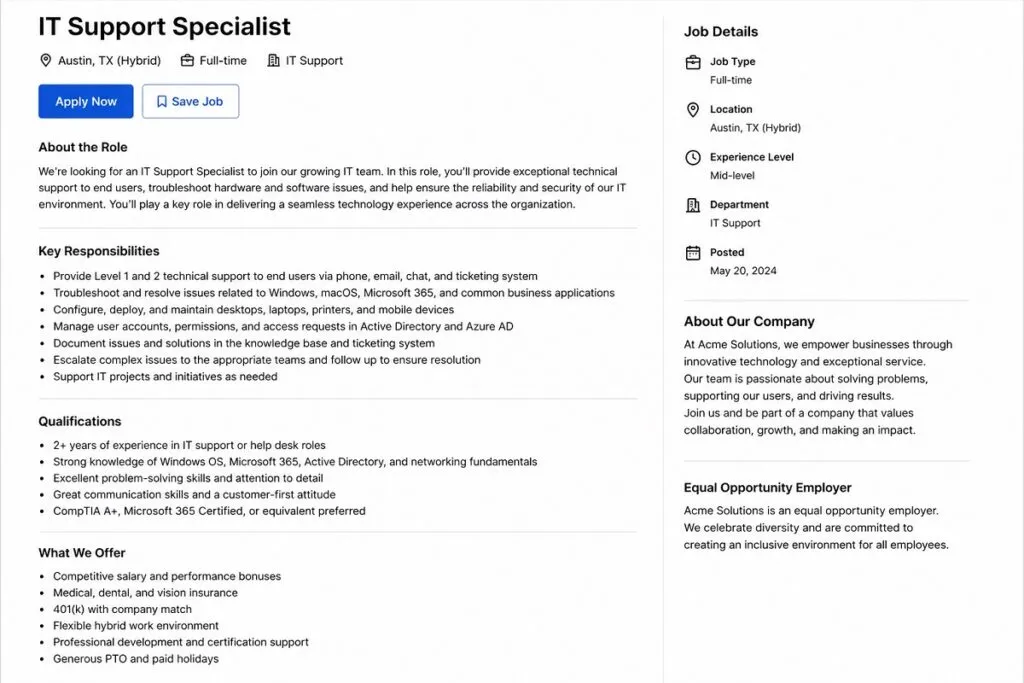
Well-written job descriptions not only attract better candidates but also improve visibility in search engines.
Best practices for SEO-optimized job listings
- Include high-value keywords such as “enterprise IT support specialist”, “IT help desk engineer”, and “technical support analyst”
- Clearly outline responsibilities and required skills
- Use concise formatting with bullet points for readability
- Avoid generic language that fails to differentiate the role
Example keyword integration
Instead of vague phrasing, use targeted language like:
- “Provide enterprise-level IT support across global infrastructure”
- “Manage high-volume IT support tickets within SLA requirements”
This approach improves both search rankings and candidate engagement.
Interviewing for Enterprise IT Support Roles

Interviews should go beyond basic technical questions and simulate real workplace scenarios.
Effective interview techniques
Scenario-based questions
Ask candidates how they would handle specific situations such as system outages or security incidents.
Live troubleshooting exercises
Provide a mock issue and evaluate the candidate’s problem-solving process.
Behavioral assessments
Determine how candidates interact with users and handle stress.
Sample evaluation criteria
- Accuracy of technical solutions
- Communication clarity
- Logical troubleshooting approach
- Adaptability to new information
Managing High-Volume Hiring Needs

Enterprise companies often need to scale IT support teams quickly during growth phases, mergers, or system upgrades.
Strategies for scaling hiring
- Partner with specialized IT recruitment agencies
- Use contract-to-hire models for flexibility
- Implement referral programs within existing teams
- Build relationships with technical training institutions
Benefits of scalable hiring approaches
- Faster onboarding during demand spikes
- Reduced hiring bottlenecks
- Access to a broader talent pool
Retention Considerations During Hiring
Hiring the right candidate is only part of the equation. Retention should be considered from the beginning of the recruitment process.
Factors that influence retention
- Clear expectations during hiring
- Competitive compensation aligned with market rates
- Opportunities for internal advancement
- Supportive team structures and management
How hiring impacts retention
Candidates who fully understand their role and responsibilities are more likely to stay long-term. Transparency during the hiring process reduces turnover and improves team stability.
Common Challenges in IT Support Hiring for Enterprise Companies
Even with strong processes, enterprise hiring comes with unique challenges.
Frequent obstacles
- High competition for skilled IT professionals
- Difficulty assessing real-world technical ability
- Long hiring cycles that result in candidate drop-off
- Misalignment between HR and technical teams
Solutions to overcome these challenges
- Streamline interview stages to reduce delays
- Use practical assessments instead of theoretical questions
- Maintain clear communication with candidates throughout the process
- Regularly update hiring criteria based on evolving technology needs
Measuring Hiring Success

Tracking performance metrics helps refine IT support hiring strategies over time.
Key metrics to monitor
- Time to hire
- Quality of hire based on performance reviews
- Ticket resolution efficiency of new hires
- Employee retention rates
Using data to improve hiring
Analyze trends to identify bottlenecks and adjust recruitment strategies accordingly. Continuous optimization ensures long-term success in building strong IT support teams.
Strong IT support hiring for enterprise companies directly impacts operational efficiency, employee satisfaction, and system reliability. By focusing on structured processes, clear role definitions, and practical skill evaluation, hiring managers and HR professionals can build teams that support complex environments effectively and consistently.
Content reviewed and published by Tier2Tek Staffing Editorial Team.