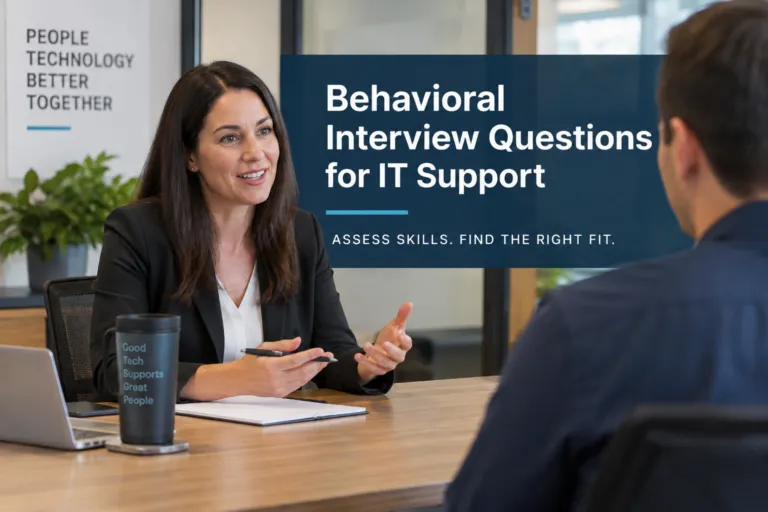
Behavioral interview questions for IT support help hiring managers evaluate how candidates have handled technical problems, frustrated users, competing priorities, and difficult support situations in previous roles. Technical knowledge is important, but an IT support professional also needs communication skills, sound judgment, patience, troubleshooting ability, and the discipline to follow an issue through to resolution.
For hiring managers and HR teams, the right behavioral questions can reveal how a candidate actually approaches IT support rather than simply what they know about technology. Past examples can provide useful insight into how someone may respond to password issues, hardware failures, software problems, network connectivity incidents, escalations, demanding users, and high-volume help desk environments.
What to Look for in IT Support Behavioral Interview Answers
Strong answers should provide more than a general statement such as, “I am good at troubleshooting.” Candidates should be able to describe a specific situation, explain the actions they personally took, and discuss the outcome.
Listen for evidence of a structured troubleshooting process. A strong IT support candidate should be able to gather information, narrow down possible causes, test solutions, communicate with the user, document the issue, and escalate when necessary.
Hiring managers should also pay attention to whether the candidate takes ownership of problems. Even when an issue must be escalated to another technician or team, a good support professional understands the importance of keeping the user informed and providing a clear handoff.
Useful qualities to evaluate include:
- Troubleshooting and problem-solving skills
- Customer service and user support
- Verbal and written communication
- Ticket prioritization
- Technical documentation
- Patience under pressure
- Accountability and follow-through
- Escalation judgment
- Time management
- Collaboration with other IT teams
- Ability to explain technical information to nontechnical users
Behavioral Interview Questions About IT Troubleshooting
Troubleshooting is at the center of most IT support and help desk positions. Behavioral interview questions should explore how candidates investigate problems when the cause is not immediately obvious.
Tell Me About a Difficult Technical Problem You Troubleshot
This question gives candidates an opportunity to demonstrate their technical problem-solving process.
A strong response should explain the initial symptoms, how the candidate gathered information, what possible causes were considered, which troubleshooting steps were performed, and how the problem was ultimately resolved.
Hiring managers should pay particular attention to the sequence of events. Candidates who approach troubleshooting methodically are often better equipped to handle unfamiliar problems than those who immediately jump to a solution.
Useful follow-up questions include:
- What did you check first?
- How did you narrow down the possible causes?
- What troubleshooting steps did you try that did not work?
- How did you confirm the issue was resolved?
- Did you document the solution?
Sample Answer:
“A user kept losing network connectivity even after restarting their computer. I checked the adapter settings, drivers, and connection logs and found an outdated network driver. After updating it and testing the connection, the issue was resolved.”
Tell Me About a Time You Did Not Know the Solution to a Technical Issue
IT support professionals will inevitably encounter problems they have never seen before. The important consideration is how they respond when they do not immediately know the answer.
Look for candidates who are comfortable acknowledging uncertainty while continuing to investigate the problem. Strong answers may involve checking internal documentation, reviewing logs, reproducing the issue, consulting a knowledge base, working with another technician, or escalating to the appropriate team.
Be cautious when a candidate suggests that they rarely encounter problems they cannot solve. IT environments are too varied for one person to know every answer.
Sample Answer:
“I received an application error I had never encountered before. I reviewed the logs and our knowledge base, tested a few possible solutions, and then consulted a senior technician. We identified the cause, resolved it, and I documented the fix for future tickets.”
Behavioral Interview Questions About Customer Service
An IT support employee may spend a large portion of the workday interacting with people who are experiencing problems. Those users may be confused, stressed, impatient, or unable to clearly describe what is happening.
Behavioral interview questions for IT support should therefore evaluate customer service skills alongside technical ability.
Describe a Time You Helped a Frustrated User
This question can reveal how a candidate handles pressure without allowing a difficult interaction to interfere with troubleshooting.
Look for answers that demonstrate patience, active listening, and professional communication. Strong candidates typically acknowledge the user’s concern, gather the necessary information, explain what they are doing, and avoid becoming defensive.
The goal is not simply to make the user happy. The candidate should demonstrate the ability to balance customer service with effective technical support.
Sample Answer:
“A user was frustrated because they could not access an important file before a meeting. I listened to the issue, explained what I was checking, and restored their access. Keeping them informed helped calm the situation while I worked.”
Tell Me About a Time You Had to Explain a Technical Issue to a Nontechnical Person
IT support technicians regularly communicate with employees who do not understand technical terminology. Candidates should be able to translate a technical problem into language the user can understand.
Strong responses often show that the candidate adjusted the explanation based on the user’s technical comfort level. They may have avoided acronyms, provided simple instructions, used an analogy, or walked the person through the solution one step at a time.
Hiring managers should look for candidates who can simplify information without speaking down to users.
Sample Answer:
“A user was having trouble understanding why their account kept locking. I avoided technical terminology and explained the cause in simple terms, then walked them through updating their saved credentials. They were able to understand the issue and prevent it from happening again.”
Behavioral Questions About Help Desk Prioritization
IT support teams often receive several requests at once. A forgotten password, failed executive laptop, company-wide application outage, and new employee setup may all enter the queue within a short period.
The ability to determine what needs immediate attention is an important part of IT support.
Tell Me About a Time You Had Multiple High-Priority Tickets
Candidates should explain how they assessed urgency and business impact rather than simply handling tickets in the order they arrived.
A strong answer may reference factors such as:
- Number of users affected
- Severity of the business impact
- Security implications
- Service-level agreements
- Executive or business-critical systems
- Availability of a workaround
- Established escalation procedures
The candidate should also discuss communication. When several issues compete for attention, keeping affected users informed can be almost as important as the technical work itself.
Sample Answer:
“I had several urgent tickets come in at once, including one affecting multiple employees. I prioritized the issue with the greatest business impact, communicated expected delays to the other users, and worked through the remaining tickets based on urgency.”
Describe a Time You Had to Change Priorities During Your Shift
IT support priorities can change quickly. A technician may be working on routine tickets when a network outage or critical application failure requires immediate attention.
Look for candidates who can reorganize their workload without losing track of existing responsibilities. Strong answers should demonstrate adaptability, documentation, and communication with users or team members whose requests may be delayed.
Sample Answer:
“I was working through routine support tickets when several users suddenly lost access to a critical application. I paused the lower-priority tickets, notified the affected users, and focused on the outage until service was restored.”
Behavioral Interview Questions About Escalations
Knowing when to escalate an IT support issue is an important judgment call. Escalating everything wastes senior technical resources, while waiting too long can increase downtime and frustrate users.
Tell Me About a Time You Had to Escalate a Support Issue
Candidates should be able to explain why escalation became necessary and what information they provided to the next support level.
A quality escalation should include relevant troubleshooting history, symptoms, error messages, affected systems, user impact, and any actions already taken. This prevents another technician from repeating the same diagnostic work.
Strong candidates understand that escalation is not failure. It is part of an effective support process when an issue exceeds their permissions, expertise, available resources, or assigned support level.
Sample Answer:
“I exhausted the troubleshooting steps available at my support level and determined the issue required administrator access. I escalated it with detailed notes, error messages, and everything I had already tested so the next technician could continue without starting over.”
Tell Me About a Time an Escalation Was Returned to You
This question can uncover how candidates respond to feedback and additional troubleshooting requests.
Listen for accountability rather than blame. A strong candidate should be willing to gather additional information, perform requested tests, improve documentation, and continue working toward a resolution.
Sample Answer:
“A senior technician returned an escalation because additional logs were needed. I gathered the requested information, performed another test, updated the ticket, and sent it back with complete documentation.”
Behavioral Questions About Mistakes and Accountability
Mistakes can happen in IT support, particularly when technicians work with user accounts, system configurations, devices, permissions, and software.
The way a candidate responds to a mistake can provide valuable information about reliability and professional judgment.
Tell Me About a Mistake You Made While Providing IT Support
Good candidates should be able to discuss a real mistake without shifting responsibility to someone else.
Their response should focus on what happened, how they recognized the problem, what they did to correct it, and what procedural change helped prevent the same issue from happening again.
Pay attention to whether the candidate notified the appropriate people quickly. Attempting to hide an IT mistake can create a much larger operational or security problem.
Sample Answer:
“I once changed the wrong user setting while troubleshooting an account issue. I recognized the mistake, corrected it immediately, notified the user, and added an extra verification step to my process before making account changes.”
Behavioral Interview Questions About Teamwork
Help desk and IT support professionals rarely operate completely independently. They may work with system administrators, network engineers, cybersecurity teams, application teams, vendors, and other support technicians.
Describe a Time You Worked With Another IT Team to Resolve an Issue
Look for evidence that the candidate can collaborate without simply passing responsibility to another department.
A strong response should explain what information was shared, how responsibilities were divided, and how the teams communicated until the problem was resolved.
Candidates who understand the boundaries between support teams while remaining focused on the user’s problem can be especially valuable in larger IT environments.
Sample Answer:
“I worked with the network team on a connectivity problem affecting several users. I gathered device information and troubleshooting results while they investigated the network side. Sharing clear information helped us identify and resolve the problem faster.”
Tell Me About a Disagreement You Had With Another Technician
Technical professionals do not always agree on the cause of a problem or the best solution.
Candidates should demonstrate that they can discuss technical disagreements professionally, use evidence to support their position, and remain open to another person’s reasoning. The strongest answers focus on solving the problem rather than proving who was right.
Sample Answer:
“Another technician and I had different ideas about what was causing an application issue. We compared the logs and tested both possibilities rather than arguing over the solution. The testing identified the cause, and we resolved the issue together.”
Behavioral Questions About Documentation
Accurate documentation improves ticket handoffs, recurring issue resolution, reporting, and knowledge sharing across an IT support team.
Tell Me About a Time Your Documentation Helped Resolve an IT Problem
This question helps hiring managers determine whether documentation is an actual part of the candidate’s workflow rather than an afterthought.
Strong candidates may describe creating a knowledge base article, recording a recurring fix, documenting troubleshooting steps, or leaving detailed ticket notes that allowed another technician to continue the work.
Look for documentation that is clear enough for another IT professional to understand without needing additional explanation.
Sample Answer:
“I documented the troubleshooting steps for a recurring software issue after resolving it. When another technician received the same problem later, they used my notes to resolve the ticket quickly without repeating the entire investigation.”
Behavioral Interview Questions About Remote IT Support
Remote and hybrid workplaces have increased the importance of troubleshooting problems when the technician cannot physically access the user’s computer or equipment.
Tell Me About a Difficult Issue You Resolved Remotely
A candidate’s answer should demonstrate both technical troubleshooting and communication skills.
Because the technician may not be able to physically inspect the device, effective remote support requires precise questions and clear instructions. Candidates may discuss remote desktop tools, screenshots, diagnostic information, video calls, or guiding users through troubleshooting steps.
Look for candidates who can maintain control of the troubleshooting process while keeping instructions simple for the user.
Sample Answer:
“A remote employee could not connect to the company VPN. I used remote support tools to check their settings, found an incorrect configuration, corrected it, and had the user reconnect successfully before ending the session.”
Behavioral Questions About High-Pressure IT Incidents
Not every support request carries the same level of pressure. System outages, executive issues, security concerns, or widespread application failures may require technicians to work quickly while maintaining accuracy.
Describe a Time You Worked on a Critical IT Issue
Strong candidates should explain how they stayed organized while responding to the incident.
Look for evidence that the candidate gathered facts before making changes, followed escalation procedures, communicated with stakeholders, documented actions, and avoided making rushed decisions that could worsen the problem.
A candidate’s ability to remain methodical during a high-impact incident can be a strong indicator of performance in a busy IT support environment.
Sample Answer:
“A business-critical application became unavailable to multiple users. I confirmed the scope, documented the symptoms, notified the appropriate team, and kept users updated while we worked on the issue. Service was restored, and all troubleshooting steps were documented.”
How to Evaluate Behavioral Interview Responses for IT Support Roles
Hiring managers should evaluate behavioral responses consistently rather than relying entirely on whether a candidate’s story sounds impressive.
One useful approach is to assess each answer across four areas: situation, action, technical reasoning, and result.
Situation
Did the candidate clearly explain the problem and its impact?
The interviewer should understand who or what was affected and why the issue required attention.
Action
What did the candidate personally do?
Candidates sometimes describe what “we” did without clarifying their individual contribution. Follow-up questions can help determine the candidate’s actual responsibilities.
Technical Reasoning
Why did the candidate choose those troubleshooting steps?
This is particularly important for IT support interviews. Two candidates may arrive at the same solution, but the person who can explain the reasoning behind the troubleshooting process may demonstrate stronger technical judgment.
Result
Was the issue resolved, escalated, documented, or otherwise brought to an appropriate outcome?
The result does not always need to be perfect. In some cases, the most useful behavioral examples involve situations that did not go according to plan. What matters is whether the candidate can explain the outcome and take responsibility for their part in it.
Red Flags in IT Support Behavioral Interview Answers
Behavioral interview responses can also reveal potential concerns that may not appear on a resume.
Hiring managers may want to investigate further when a candidate:
- Consistently blames users for technical problems
- Cannot provide specific examples from previous support work
- Skips basic troubleshooting and immediately escalates
- Makes significant system changes without explaining validation steps
- Shows little concern for documenting tickets
- Uses excessive technical jargon when describing user interactions
- Focuses only on closing tickets instead of resolving user problems
- Cannot explain how priorities were determined
- Takes credit for team accomplishments without identifying personal contributions
- Describes disagreements primarily in terms of who was right or wrong
A single weak answer should not automatically eliminate a candidate. Patterns across several responses are usually more informative than one imperfect example.
Matching Behavioral Questions to the IT Support Position
The best behavioral interview questions should reflect the actual responsibilities of the open position.
For an entry-level help desk role, hiring managers may place greater emphasis on customer service, troubleshooting fundamentals, ticket documentation, password and account support, desktop issues, and knowing when to escalate.
For a more experienced IT support specialist or Tier 2 support position, questions can explore complex troubleshooting, endpoint management, Active Directory or identity-related issues, Microsoft 365 support, networking problems, escalations, remote support, and collaboration with infrastructure teams.
The interview should reflect the environment as well. An internal corporate IT department may require different behavioral examples than a managed service provider, high-volume service desk, or field support position.
Building a Consistent IT Support Interview Process
Using the same core behavioral interview questions for candidates applying to the same position can make comparisons more useful.
Hiring teams can create a simple scoring system for important competencies such as troubleshooting, communication, customer service, prioritization, documentation, escalation judgment, and accountability.
Interviewers should also use follow-up questions when answers are vague. Asking “What did you personally do?” or “How did you determine that was the cause?” often provides considerably more information than moving immediately to the next interview question.
Behavioral interview questions for IT support are most effective when they require candidates to demonstrate how they have handled real technical and user-facing situations. A resume can show technologies, certifications, and years of experience, but detailed examples help hiring managers understand how that experience is applied.
For HR teams and hiring managers recruiting help desk technicians, desktop support specialists, IT support specialists, and Tier 2 support professionals, combining targeted behavioral questions with technical evaluation can provide a clearer picture of each candidate’s troubleshooting ability, communication skills, judgment, and approach to supporting users.