
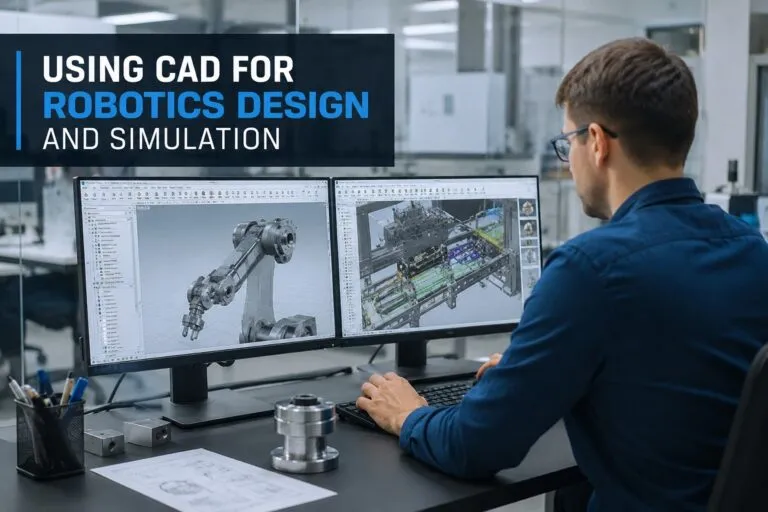
Using CAD for robotics design and simulation gives engineering teams the ability to develop, refine, and validate robotic systems with greater precision before production begins. From industrial automation and warehouse robotics to medical devices and autonomous equipment, CAD software supports every stage of robotic development by improving mechanical design, testing motion, and identifying potential issues early. For organizations hiring CAD professionals, understanding how CAD contributes to robotics projects helps identify candidates with the technical expertise needed to support increasingly complex engineering initiatives.
CAD Improves Mechanical Design Accuracy for Robotics
Robotic systems depend on highly accurate mechanical components that must work together with minimal tolerance for error. CAD software allows engineers and designers to build detailed 3D models that represent every component before manufacturing begins.
By developing accurate digital models, engineering teams can:
- Verify dimensions and tolerances
- Reduce design inconsistencies
- Improve component fit and alignment
- Simplify assembly planning
- Detect interference between moving parts
Every joint, bracket, housing, arm, gearbox, and mounting point can be evaluated within the complete assembly. This reduces costly revisions later in the development process while improving overall product quality.
Motion Simulation Helps Validate Robotic Performance
One of the greatest advantages of CAD in robotics design is the ability to simulate movement before physical prototypes are built.
Motion simulation allows engineers to evaluate how robotic assemblies behave throughout their full operating range. Designers can observe arm movement, rotational limits, linear travel, and interactions between multiple mechanical systems.
Simulation makes it easier to identify:
- Joint collisions
- Mechanical interference
- Restricted movement
- Excessive component stress
- Reach limitations
- Workspace constraints
Instead of discovering problems during prototype testing, engineering teams can correct issues while the design remains entirely digital.
Assembly Modeling Supports Complex Robotic Systems
Modern robots often contain hundreds or even thousands of individual components. CAD software provides powerful assembly modeling tools that organize these parts into manageable systems.
Large assemblies may include:
- Structural frames
- Robotic arms
- Linear actuators
- Servo motors
- Bearings
- Gearboxes
- Sensors
- Protective enclosures
- Fasteners
- Electrical mounting hardware
Assembly modeling allows designers to understand how every component interacts within the larger robotic platform while maintaining accurate relationships between parts.
This approach simplifies collaboration among mechanical engineers, manufacturing teams, and design departments working on the same project.
Collision Detection Prevents Costly Design Problems
Collision detection is an essential part of robotics design and simulation.
Robotic equipment frequently operates in confined environments where moving components pass within very small clearances. CAD simulation identifies collisions before production begins, allowing engineers to modify geometry or movement paths early in development.
Collision analysis helps prevent problems involving:
- Robotic arm interference
- End effector collisions
- Housing contact
- Cable routing conflicts
- Sensor obstruction
- Fixture interference
Early identification reduces redesign costs while improving equipment reliability.
Kinematic Analysis Improves Robot Motion
Kinematic analysis enables engineering teams to study robotic movement without building physical prototypes.
CAD software evaluates how links, pivots, gears, and actuators move together through a complete motion cycle. Designers can analyze velocity, acceleration, rotational movement, and mechanical relationships between connected components.
Benefits include:
- Improved motion efficiency
- Better positioning accuracy
- Reduced unnecessary movement
- Enhanced cycle time optimization
- Smoother mechanical operation
These improvements directly influence productivity in manufacturing, material handling, packaging, and automated inspection systems.
Design Validation Before Manufacturing
Building robotic prototypes can be expensive and time consuming.
CAD design validation significantly reduces risk by allowing engineers to verify multiple aspects of a design before fabrication.
Validation often includes:
- Dimensional verification
- Assembly fit
- Structural integrity
- Motion testing
- Material evaluation
- Manufacturing feasibility
When design problems are identified during digital development, engineering teams avoid expensive prototype revisions and production delays.
Structural Analysis Strengthens Robotic Components
Many CAD platforms integrate finite element analysis (FEA), allowing engineers to evaluate structural performance under real operating conditions.
Robotic components often experience repetitive loading, vibration, acceleration, and varying payloads. Structural analysis identifies areas where stress concentrations may develop before manufacturing begins.
Engineers can evaluate:
- Frame rigidity
- Arm deflection
- Mounting strength
- Joint durability
- Load distribution
- Material performance
This analysis improves reliability while helping optimize component weight and manufacturing costs.
Optimizing Robotic End Effectors
End effectors perform the actual work of a robotic system, making their design especially important.
Whether handling delicate electronics, automotive components, medical devices, or warehouse inventory, CAD software helps engineers optimize every aspect of the end effector.
Design considerations include:
- Grip geometry
- Range of motion
- Tool accessibility
- Weight reduction
- Structural strength
- Mounting compatibility
Simulation also verifies whether the end effector can complete required tasks without interfering with surrounding equipment.
Cable and Component Routing
Robotic systems rely on electrical wiring, pneumatic tubing, hydraulic lines, and communication cables that must move safely throughout repeated operating cycles.
CAD software assists engineers by planning routing paths that minimize wear while maintaining serviceability.
Proper routing reduces:
- Cable fatigue
- Pinching
- Abrasion
- Excessive bending
- Maintenance difficulties
- Unexpected downtime
Well planned routing contributes to longer equipment life and improved system reliability.
Digital Prototyping Reduces Development Time
Digital prototyping has become a major advantage in robotics engineering.
Instead of producing multiple physical prototypes, engineering teams can evaluate several design variations using CAD simulation.
Teams can compare different:
- Mechanical layouts
- Joint configurations
- Material selections
- Actuator sizes
- Mounting options
- Component locations
This flexibility allows organizations to refine designs more quickly while reducing engineering costs and accelerating product development schedules.
Manufacturing Preparation Becomes More Efficient
Once robotic designs are validated, CAD data supports downstream manufacturing processes.
Engineering models generate accurate documentation for fabrication, machining, inspection, and assembly.
Common manufacturing outputs include:
- Detailed engineering drawings
- Bill of materials (BOM)
- Assembly instructions
- Exploded views
- Machining dimensions
- Manufacturing tolerances
Accurate CAD documentation improves communication between engineering, production, and quality teams while reducing manufacturing errors.
Collaboration Across Engineering Teams
Robotics projects typically involve mechanical engineers, electrical engineers, controls specialists, manufacturing engineers, and project managers.
CAD platforms support collaboration by providing centralized design data that multiple teams can review throughout development.
Benefits include:
- Better version control
- Faster design reviews
- Easier design revisions
- Improved communication
- Consistent documentation
- Reduced project delays
When everyone works from the same digital model, design changes can be evaluated more efficiently across departments.
Skills Employers Seek in CAD Professionals Supporting Robotics
As robotics adoption continues across manufacturing, logistics, healthcare, aerospace, and automation industries, employers seek CAD professionals who can contribute to sophisticated design projects.
Hiring managers often look for candidates with experience in:
- 3D CAD modeling
- Robotics assembly design
- Motion simulation
- Mechanical drafting
- Tolerance analysis
- Design validation
- Finite element analysis
- Manufacturing documentation
- Design for manufacturability (DFM)
- Collaboration within cross functional engineering teams
Professionals who combine strong CAD expertise with practical robotics experience often bring immediate value to engineering organizations working on automation initiatives.
Companies looking to strengthen their engineering teams frequently partner with specialized recruiters that understand technical hiring requirements. Tier2Tek recruits experienced CAD designers, CAD engineers, and IT support professionals who possess the technical skills organizations need to complete complex engineering projects. Learn more at https://tier2tek.com.
CAD for robotics design and simulation enables engineering teams to develop more accurate, reliable, and efficient robotic systems while reducing costly design revisions. Through advanced modeling, motion simulation, collision detection, structural analysis, and digital prototyping, organizations can validate designs long before manufacturing begins. For hiring managers building engineering teams, recruiting skilled CAD professionals with robotics experience can significantly improve project quality, development speed, and long term product success.
Content reviewed and published by Tier2Tek Staffing Editorial Team.