
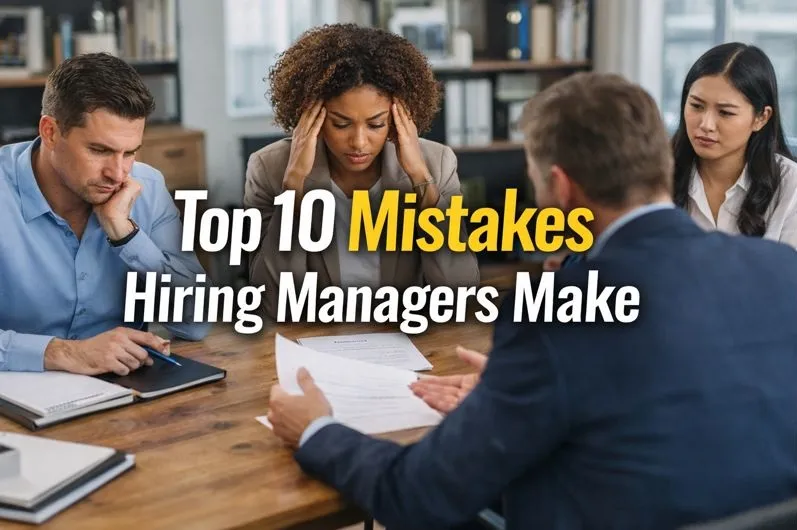
Top 10 mistakes hiring managers make can quietly undermine hiring outcomes, increase turnover, and weaken team performance. Even experienced hiring managers fall into patterns that lead to missed talent, slow hiring cycles, and poor long-term fits. Addressing these mistakes improves hiring quality, candidate experience, and retention.
1. Relying Too Heavily on Gut Instinct
Many hiring managers trust intuition over evidence when evaluating candidates. While experience has value, gut-based decisions are often influenced by unconscious bias, first impressions, or personal similarity.
This approach tends to favor candidates who are charismatic or familiar rather than those best equipped to perform the job. Structured evaluation methods help reduce bias and improve decision accuracy.
2. Writing Unclear or Unrealistic Job Requirements
Poorly defined job requirements create confusion at every stage of the hiring process. Vague descriptions attract mismatched applicants, while unrealistic expectations discourage strong candidates from applying.
Common issues include:
- Excessive experience requirements
- Overloaded responsibilities
- Credential-based screening instead of skill-based criteria
Clear, outcome-focused job descriptions help align hiring managers and candidates from the start.
3. Moving Too Slowly and Losing Top Candidates

Lengthy hiring processes remain one of the most costly hiring mistakes. Delays caused by scheduling issues, approval bottlenecks, or indecision often result in losing top talent to faster-moving competitors.
High-performing candidates are rarely available for long. A slow process sends the message that the organization lacks urgency or clarity.
4. Ignoring the Candidate Experience
Hiring managers sometimes underestimate how much the interview process shapes employer perception. Poor communication, long gaps between interviews, and unprepared interviewers quickly erode trust.
Negative candidate experiences can:
- Lead to offer rejections
- Damage employer reputation
- Reduce future applicant interest
Every interaction influences how candidates view the organization.
5. Conducting Unstructured Interviews

Unstructured interviews may feel conversational but rarely produce reliable hiring decisions. Without consistent questions or evaluation criteria, comparisons between candidates become subjective.
Unstructured interviews often:
- Favor strong communicators over strong performers
- Increase unconscious bias
- Fail to assess job-specific skills
Structured interviews improve fairness and consistency across candidates.
6. Overvaluing Credentials Instead of Skills
Many hiring managers rely too heavily on resumes, degrees, and past job titles. Credentials do not always reflect a candidate’s ability to perform the role effectively.
Skills-based hiring focuses on:
- Problem-solving ability
- Practical experience
- Transferable competencies
This approach expands the talent pool and improves job performance outcomes.
7. Hiring for Culture Fit Rather Than Team Impact

Hiring for culture fit can unintentionally limit diversity and innovation. When fit is defined by similarity rather than values, teams become less adaptable.
Effective hiring prioritizes:
- Alignment with core values
- Professional behavior
- Contribution to team strengths
Hiring managers benefit from seeking candidates who add new perspectives and capabilities.
8. Showing Up Unprepared for Interviews
Interview preparation is essential but often overlooked. When hiring managers skim resumes or improvise questions, interviews lose focus and credibility.
Lack of preparation leads to:
- Missed evaluation opportunities
- Repetitive or irrelevant questions
- Negative candidate impressions
Preparation signals professionalism and respect.
9. Treating Hiring as Complete Once the Offer Is Accepted
Many hiring managers disengage after extending an offer, assuming their role is finished. Poor onboarding can quickly undo a strong hiring decision.
According to Gallup, employees who experience effective onboarding are more engaged and more likely to stay.
Hiring managers who remain involved during onboarding help new hires integrate faster and perform sooner.
10. Treating Hiring as a Transaction Instead of a Relationship
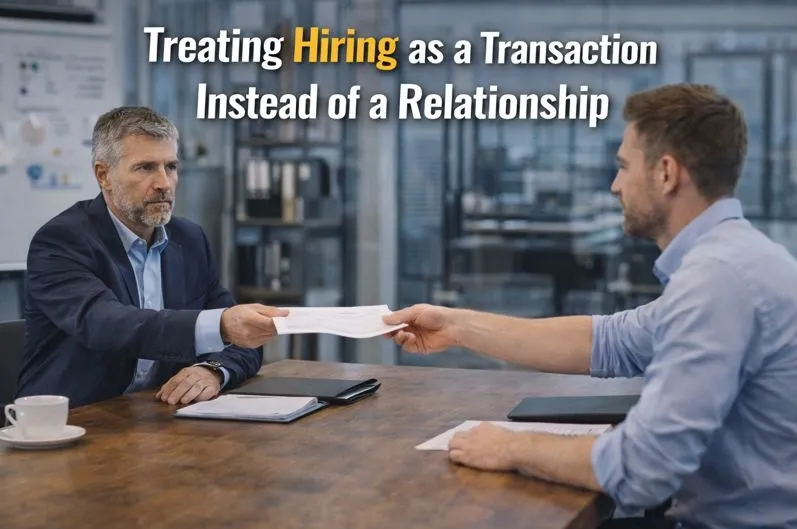
Transactional hiring focuses on filling roles quickly rather than building meaningful connections with candidates. This mindset reduces engagement and limits long-term talent pipelines.
Strong hiring managers:
- Communicate transparently
- Build rapport throughout the process
- Maintain relationships with high-potential candidates
This approach strengthens employer branding and supports future hiring success.
Top 10 mistakes hiring managers make often stem from outdated practices, rushed decisions, or lack of structure. Improving hiring outcomes requires clear expectations, consistent evaluation, timely communication, and involvement beyond the offer stage. Hiring managers who address these issues build stronger teams and create a hiring process that attracts and retains top talent.
Content reviewed and published by Tier2Tek Staffing Editorial Team .