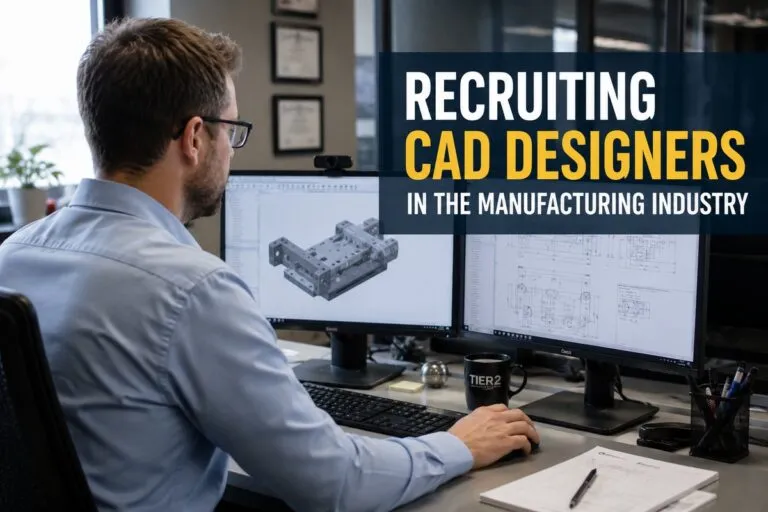
Recruiting CAD designers in the manufacturing industry requires a hiring approach that accounts for technical design skills, manufacturing knowledge, software proficiency, and the specific processes used on the production floor. Hiring managers and HR teams are often looking for candidates who can do more than create accurate drawings. They need CAD professionals who understand how designs translate into components, assemblies, tooling, and finished products.
Competition for experienced CAD designers can make direct hire recruiting especially challenging. The strongest candidates may have specialized experience with particular CAD platforms, manufacturing methods, materials, or product categories, which can significantly narrow the available talent pool.
A focused recruiting strategy helps manufacturers identify candidates who meet the technical requirements of the position while also fitting the company’s workflow, engineering environment, and long-term hiring needs.
Understanding the Requirements Before Recruiting CAD Designers
Successful CAD designer recruitment starts with a detailed understanding of the position. A generic job description that simply requests CAD experience can attract a large number of applicants without producing many qualified candidates.
Hiring managers should identify the actual work the designer will perform and the technical environment they will enter. This includes the products being designed, software used by the engineering team, manufacturing processes involved, and level of responsibility assigned to the position.
Important requirements to establish include:
- Required CAD software and preferred versions
- 2D drafting versus 3D modeling responsibilities
- Part and assembly design requirements
- Manufacturing processes used by the company
- Materials the candidate will work with
- GD&T knowledge requirements
- Engineering drawing and documentation responsibilities
- Product lifecycle management or PDM system experience
- Years and type of manufacturing experience
- Industry-specific standards or regulations
- Education, certification, and training requirements
- Collaboration expectations with engineers, machinists, and production teams
Separating required qualifications from preferred qualifications can also expand the candidate pool. A talented designer who has extensive SolidWorks experience, for example, may be able to transition into another parametric CAD platform even if that platform is not currently their primary software.
Identifying the Right CAD Software Experience
Software proficiency is one of the most important considerations when recruiting CAD designers for manufacturing companies. However, hiring teams should evaluate more than whether a particular software package appears on a resume.
Match CAD Skills to the Manufacturing Environment
Different manufacturers rely on different design platforms depending on their products, engineering processes, customer requirements, and existing systems.
Common platforms may include:
- AutoCAD
- SolidWorks
- Autodesk Inventor
- Creo
- CATIA
- Siemens NX
- Solid Edge
A candidate’s depth of experience is often more important than simply having used the software. Someone who has spent several years building complex assemblies and production drawings may have significantly stronger capabilities than a candidate who occasionally used the same platform.
Recruiters should determine exactly how the software is used within the organization before screening candidates.
Evaluate Transferable CAD Experience
Requiring exact software experience can unnecessarily restrict a search.
Many experienced mechanical designers and CAD designers understand fundamental concepts such as parametric modeling, assemblies, drawing creation, dimensioning, tolerances, and design revisions. Those skills can transfer between platforms.
When the candidate has strong manufacturing knowledge and closely related CAD experience, hiring managers should consider whether software training could close the remaining gap.
Look for Manufacturing Knowledge, Not Just CAD Ability
Manufacturing CAD designers need to understand how their drawings and models will ultimately be produced. A design may look correct on a screen while creating unnecessary difficulties or costs during manufacturing.
Candidates with practical manufacturing knowledge can recognize these issues earlier in the design process.
Experience With Relevant Manufacturing Processes
The manufacturing process should influence the type of CAD candidate being recruited.
A company producing sheet metal assemblies may prioritize experience with bend allowances, flat patterns, forming, welding, and fabrication drawings. A CNC machining operation may place greater emphasis on tolerances, machinability, material selection, and detailed part drawings.
Depending on the company, relevant experience could include:
- CNC machining
- Sheet metal fabrication
- Welding
- Injection molding
- Tool and die
- Metal stamping
- Plastics manufacturing
- Additive manufacturing
- Assembly operations
- Fixture and tooling design
Hiring a CAD designer with experience that closely matches the company’s manufacturing processes can shorten onboarding time and improve communication between design and production teams.
Evaluate GD&T and Technical Drawing Skills
Geometric Dimensioning and Tolerancing can be a critical skill for manufacturing CAD positions. Candidates may list GD&T on their resumes, but proficiency can vary considerably.
Recruiting teams should determine the level of GD&T knowledge the position actually requires.
For roles involving precision components, complex assemblies, aerospace parts, automotive components, or tightly controlled manufacturing processes, candidates may need a strong understanding of datums, feature control frames, positional tolerances, profile tolerances, and tolerance stack-ups.
Review the Candidate’s Drawing Experience
A CAD designer’s ability to create usable manufacturing drawings is just as important as creating 3D models.
During the interview process, hiring managers can explore how candidates approach:
- Dimensioning
- Tolerance selection
- Drawing layouts
- Section and detail views
- Bills of materials
- Assembly drawings
- Revision control
- Drawing notes
- Manufacturing specifications
Questions about actual projects often provide better insight than asking candidates to rate their own abilities.
For example, asking a candidate to describe a complicated drawing they created and how they determined its tolerances can reveal considerably more about their experience.
Recruit CAD Designers Based on Product Complexity
Not every CAD designer position requires the same technical background. The complexity of the company’s products should influence recruiting criteria.
A designer producing straightforward production drawings may require a different skill set than someone responsible for complex machinery with hundreds of components.
Consider Assembly and Mechanical Design Experience
Manufacturers producing equipment, machinery, or multi-component products should evaluate candidates’ assembly design experience.
Relevant capabilities may include:
- Creating large assemblies
- Managing component relationships
- Checking interference and clearances
- Developing exploded views
- Producing bills of materials
- Managing configurations
- Designing moving mechanical components
- Updating designs after engineering changes
Candidates who have worked on products with a similar level of complexity are often easier to integrate into an existing engineering department.
Source Candidates Beyond Active Job Applicants
One of the biggest challenges in recruiting CAD designers is that experienced professionals are not always actively applying to job postings.
A strong CAD designer who has been working for the same manufacturer for several years may rarely visit job boards. However, that person may still be interested in a direct hire opportunity offering better compensation, stronger career progression, a shorter commute, different products, or a more appealing engineering environment.
Direct Recruiting Expands the Candidate Pool
Direct sourcing allows employers to reach both active and passive CAD candidates.
Recruiting efforts can target professionals based on:
- Current and previous job titles
- CAD software experience
- Manufacturing industry experience
- Product experience
- Geographic location
- Years of experience
- Specific technical skills
Potential titles may include CAD Designer, Mechanical Designer, CAD Drafter, Mechanical Drafter, Design Engineer, Product Designer, Engineering Designer, CAD Technician, and Mechanical Design Technician.
Searching across related job titles is important because companies frequently use different titles for very similar responsibilities.
Screen CAD Designer Resumes for Relevant Project Experience
Resume screening should focus on what candidates have actually designed rather than relying heavily on keyword matches.
A resume containing SolidWorks, AutoCAD, or Creo does not automatically indicate that the candidate has the experience required for the position.
Look for details about the candidate’s projects, such as whether they designed individual components, complex assemblies, machinery, fixtures, tooling, enclosures, structural components, or production equipment.
Look for Evidence of Manufacturing Interaction
Candidates who regularly interact with manufacturing teams may bring valuable practical knowledge to the position.
Resume descriptions may reference activities such as:
- Supporting production teams
- Resolving manufacturing problems
- Creating drawings for machinists or fabricators
- Working with CNC operations
- Updating designs based on production feedback
- Supporting prototype builds
- Performing design for manufacturability reviews
- Managing engineering change orders
- Creating or maintaining bills of materials
These responsibilities can indicate that the candidate understands the connection between engineering documentation and production.
Ask Better Technical Interview Questions
A productive CAD designer interview should focus on specific situations the candidate has encountered.
Instead of asking, “How good are you with SolidWorks?” ask the candidate to explain the most complicated assembly they have built, how many components it contained, and which features they used.
Similarly, instead of asking whether someone understands manufacturing drawings, present questions about how they determine dimensions, tolerances, materials, or drawing notes.
Useful CAD Designer Interview Topics
Hiring managers can ask candidates to discuss:
- A difficult design problem they solved
- The most complex assembly they created
- How they handle design revisions
- How they determine appropriate tolerances
- Their experience with GD&T
- How they communicate with machinists or production personnel
- A time manufacturing feedback required a design change
- Their experience creating bills of materials
- How they organize CAD files and revisions
- Their experience designing for specific manufacturing processes
These conversations make it easier to distinguish candidates who have substantial hands-on experience from those with limited exposure.
Use CAD Assessments Carefully
Technical assessments can be valuable when recruiting CAD designers, but they should reflect the responsibilities of the actual job.
An overly complicated assessment can discourage qualified candidates, particularly experienced professionals who are already employed and participating in several interview processes.
A focused CAD assessment might ask candidates to create or modify a representative part, interpret an engineering drawing, identify a design issue, or explain how they would prepare a component for manufacturing.
The goal should be to confirm competency rather than create an unnecessarily lengthy examination.
Evaluate Communication With Engineering and Production Teams
CAD designers rarely work independently from the rest of a manufacturing organization. They may communicate with mechanical engineers, manufacturing engineers, project managers, machinists, welders, quality teams, purchasing departments, and production supervisors.
Communication skills are particularly important when design problems arise.
A designer may need to understand feedback from the production floor, determine whether a drawing needs revision, discuss tolerances with engineering, or explain design intent to someone manufacturing the component.
During interviews, hiring managers should evaluate whether candidates can explain technical concepts clearly and describe how they have handled disagreements or design changes involving other departments.
Improve CAD Designer Job Descriptions
The quality of the job description can directly affect recruiting results.
CAD designer job descriptions should give candidates enough information to determine whether their experience aligns with the opportunity. Extremely broad descriptions can generate applications from candidates whose backgrounds have little connection to the actual position.
Include specific information about:
- CAD platforms
- Products being designed
- Manufacturing processes
- Typical projects
- Required technical skills
- Preferred manufacturing background
- Reporting structure
- On-site, hybrid, or remote expectations
- Compensation range when available
Avoid combining unrelated responsibilities simply to create a longer list of requirements. Prioritize the skills the successful candidate will use regularly.
Consider Compensation When Recruiting CAD Designers
Compensation can significantly affect the size and quality of the available CAD designer talent pool.
Requirements for specialized CAD software, extensive manufacturing experience, GD&T knowledge, complex mechanical design, or industry-specific expertise can increase the compensation candidates expect.
Hiring teams should compare compensation against the actual requirements of the position rather than relying only on internal job titles.
If a company requires an experienced mechanical designer who can independently create complex assemblies, develop manufacturing drawings, understand machining processes, and work directly with engineering and production, compensation should reflect that combination of skills.
Keep the Hiring Process Moving
Experienced CAD designers may receive interest from several employers at the same time. Long gaps between interviews can result in strong candidates accepting other positions before the hiring process is complete.
Manufacturing companies can improve recruiting outcomes by establishing the interview process before beginning the search.
That includes determining who will interview candidates, whether a technical assessment is required, who has final hiring authority, and how quickly feedback can be provided.
Reduce Unnecessary Interview Steps
Not every CAD designer position requires four or five interviews.
A streamlined process might include an initial screening followed by a technical interview with the engineering or design manager. Additional interviews should have a specific purpose rather than repeating questions already covered.
Fast decision-making does not mean lowering hiring standards. It means removing delays that do not improve the hiring decision.
Working With a Direct Hire CAD Recruiting Firm
Manufacturing companies with difficult-to-fill CAD openings may benefit from working with a recruiting firm that understands technical and manufacturing positions.
A specialized recruiter can actively identify candidates with the required CAD software, manufacturing experience, product knowledge, and technical background rather than relying exclusively on incoming job applications.
For employers hiring permanent CAD and technical professionals, Tier2Tek Staffing provides direct hire staffing services designed to help companies identify qualified candidates for specialized positions.
Direct hire recruiting can be especially useful when the ideal candidate is currently employed, the position requires a narrow technical skill set, or internal HR teams do not have enough time to conduct extensive candidate sourcing.
Building a More Effective CAD Designer Recruiting Process
Recruiting CAD designers in the manufacturing industry works best when hiring teams define the position precisely, identify the technical skills that truly matter, and evaluate candidates based on relevant manufacturing experience.
The strongest hiring process looks beyond CAD software keywords. It considers what candidates have designed, how well they understand manufacturing processes, their ability to produce accurate technical drawings, their GD&T knowledge, and how effectively they communicate with engineering and production teams.
Direct sourcing can also help manufacturers reach experienced CAD professionals who may never apply through a traditional job posting. When combined with focused screening, relevant technical interviews, competitive compensation, and an efficient hiring process, this approach gives employers a stronger opportunity to secure CAD designers who can contribute effectively from the design stage through production.
Content reviewed and published by Tier2Tek Staffing Editorial Team.