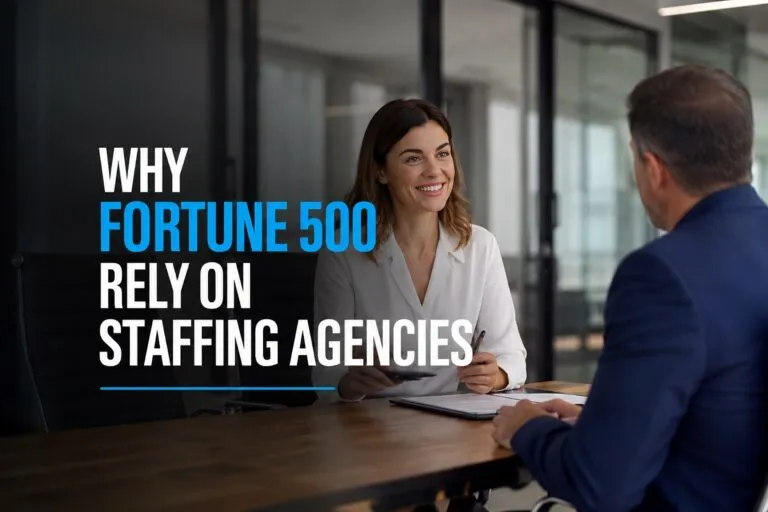
Fortune 500 companies rely on staffing agencies to solve hiring challenges, reduce time-to-fill, improve candidate quality, and maintain workforce flexibility in competitive labor markets. Even organizations with large internal recruiting teams frequently partner with specialized staffing firms to access talent faster, fill hard-to-find positions, and support business growth without overburdening internal HR departments.
As hiring demands continue to evolve, staffing agencies have become a strategic extension of talent acquisition teams. From engineering and technology positions to administrative and professional roles, Fortune 500 employers use staffing partners to strengthen recruitment efforts and gain access to highly qualified candidates.
Faster Access to Qualified Talent
Large organizations often need to fill positions quickly to avoid productivity losses, project delays, and increased workloads for existing employees.
Staffing agencies maintain extensive candidate networks and talent pipelines that allow them to identify qualified professionals much faster than traditional recruiting methods.
Benefits include:
- Reduced time-to-fill
- Immediate access to active and passive candidates
- Faster response to urgent hiring needs
- Pre-screened candidates ready for interviews
- Reduced workload for internal recruiting teams
For high-demand positions such as CAD Designers, CAD Drafters, Help Desk Technicians, Desktop Support Specialists, and IT Support Professionals, speed can make the difference between securing top talent and losing candidates to competitors.
Access to Specialized Recruiting Expertise
Many Fortune 500 companies hire for highly specialized roles that require industry knowledge and targeted recruiting strategies.
Staffing agencies that focus on specific disciplines often have recruiters who understand:
- Industry terminology
- Technical skill requirements
- Market compensation trends
- Certification requirements
- Competitive hiring conditions
For example, a staffing agency specializing in CAD staffing understands the differences between AutoCAD, Civil 3D, Revit, SolidWorks, and MicroStation professionals. Likewise, an IT staffing agency understands the technical requirements associated with help desk, desktop support, network support, systems administration, and service desk positions.
This expertise helps employers identify stronger candidates and avoid costly hiring mistakes.
Support During Rapid Growth Periods
Business growth often creates hiring demands that exceed the capacity of internal HR teams.
When organizations open new locations, launch projects, expand departments, or enter new markets, recruiting activity can increase significantly within a short period.
Staffing agencies provide scalable recruiting support by:
- Managing large hiring volumes
- Conducting candidate sourcing
- Performing preliminary screenings
- Coordinating interviews
- Supporting onboarding processes
This allows internal HR teams to maintain focus on strategic initiatives while staffing partners handle a significant portion of recruitment activities.
Access to Passive Candidates
Many of the strongest candidates are not actively searching for jobs.
These passive candidates often have stable employment, valuable experience, and highly sought-after skills. Because they are not applying through job boards, they can be difficult for employers to reach directly.
Staffing agencies invest significant time building relationships with passive talent and maintaining long-term candidate networks.
As a result, Fortune 500 companies gain access to a larger talent pool that may not be available through traditional recruitment channels.
Reduced Hiring Risks
Every hiring decision carries risk.
A poor hire can impact productivity, team morale, customer service, project timelines, and overall business performance. Replacing an employee often costs significantly more than making the right hire initially.
Staffing agencies help reduce hiring risks through:
- Candidate screening
- Employment verification
- Reference checks
- Skills assessments
- Interview preparation
- Market intelligence
These additional layers of evaluation improve hiring accuracy and help employers make more informed decisions.
Improved Recruiting Efficiency
Recruiting requires significant time and resources.
Internal recruiters often manage multiple openings simultaneously while balancing other responsibilities such as employee relations, onboarding, compliance, and workforce planning.
Staffing agencies improve efficiency by handling many labor-intensive recruiting functions, including:
Candidate Sourcing
Recruiters proactively identify candidates through databases, professional networks, referrals, and direct outreach.
Initial Screening
Staffing firms conduct preliminary interviews to evaluate qualifications, experience, communication skills, and overall fit.
Interview Coordination
Scheduling interviews can be time-consuming, especially when multiple stakeholders are involved.
Candidate Follow-Up
Recruiters maintain communication throughout the hiring process, helping reduce candidate drop-off rates.
By outsourcing portions of the hiring process, organizations can focus on final candidate selection rather than administrative recruiting tasks.
Better Workforce Flexibility
Business needs change frequently.
Seasonal demand, project-based work, product launches, system upgrades, and organizational restructuring can all impact staffing requirements.
Fortune 500 companies often use staffing agencies to maintain workforce flexibility without making long-term commitments before evaluating workforce needs.
Advantages include:
- Ability to scale hiring up or down
- Support for project-based initiatives
- Coverage for employee absences
- Faster response to market changes
- Improved workforce planning
This flexibility helps organizations remain agile in changing business environments.
Stronger Competitive Advantage in Tight Labor Markets
Competition for skilled talent remains intense across many industries.
When multiple employers pursue the same candidates, companies must move quickly and present attractive opportunities.
Staffing agencies provide competitive advantages through:
- Established candidate relationships
- Market salary insights
- Faster recruiting processes
- Larger talent networks
- Targeted sourcing strategies
These advantages can significantly improve hiring outcomes for difficult-to-fill positions.
Data and Market Intelligence
One reason Fortune 500 organizations continue to partner with staffing firms is access to valuable labor market intelligence.
Staffing agencies track hiring trends daily and often have real-time insights into:
- Candidate availability
- Salary expectations
- Hiring challenges
- Industry demand
- Regional labor market conditions
- Emerging skill requirements
This information helps hiring managers make better workforce decisions and remain competitive when attracting talent.
Filling Difficult-to-Recruit Positions
Some positions consistently present recruiting challenges because of skill shortages, specialized experience requirements, or high market demand.
Common examples include:
CAD Positions
- CAD Drafters
- AutoCAD Designers
- Civil CAD Technicians
- Revit Specialists
- Mechanical Designers
- BIM Professionals
IT Support Positions
- Help Desk Technicians
- Desktop Support Specialists
- Service Desk Analysts
- Technical Support Representatives
- Network Support Technicians
- Systems Support Analysts
Staffing agencies focused on these areas often maintain active relationships with qualified professionals, making it easier to identify candidates quickly.
Strengthening Internal Talent Acquisition Teams
Contrary to common assumptions, staffing agencies do not replace internal recruiting departments.
Instead, they often function as an extension of internal talent acquisition teams.
This partnership allows organizations to:
- Fill critical vacancies faster
- Expand recruiting capacity
- Improve candidate quality
- Reduce hiring bottlenecks
- Increase overall recruiting effectiveness
Many Fortune 500 companies view staffing firms as strategic recruiting partners rather than simply external vendors.
Fortune 500 companies rely on staffing agencies because hiring success directly impacts business performance. Access to specialized recruiting expertise, larger talent networks, faster hiring processes, and valuable market intelligence helps organizations compete for top talent while maintaining operational efficiency. Whether hiring CAD professionals, IT support specialists, engineering talent, or other skilled employees, staffing agencies continue to play a critical role in helping large employers build strong, productive workforces.
Content reviewed and published by Tier2Tek Staffing Editorial Team.