IT Hiring & Placement Solutions
Tier2Tek Staffing delivers national IT staffing solutions for employers seeking dependable, full time technology professionals. Our direct hire model is built for organizations that require reliability, security, and long term performance across complex IT environments.
Your IT Staffing Partner
Tier2Tek Staffing works with employers nationwide to support direct hire IT staffing for permanent, full time roles. Our recruiting approach focuses on business continuity, operational reliability, and long term workforce stability.
We provide direct hire staffing only. Tier2Tek does not offer contract, temporary, or project based placements. This ensures every search is aligned with retention, performance, and organizational risk management.
Employers engage Tier2Tek when internal recruiting slows, technical roles carry high risk, or hiring mistakes create operational exposure. Our national reach supports on site, hybrid, and remote hiring needs while maintaining consistent hiring standards.
What Is an IT Staffing Agency
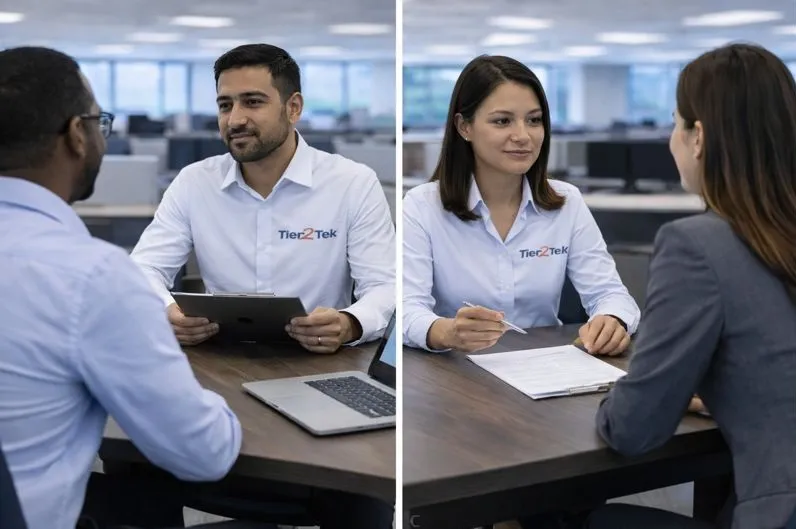
An IT staffing agency supports employers by identifying and presenting qualified technology professionals for permanent employment. These agencies manage sourcing, evaluation, and candidate presentation to reduce hiring time and decision risk.
In a direct hire model, the agency evaluates how candidates perform in real business environments, including system reliability, security exposure, and long term scalability rather than short term task completion.
How IT Staffing Agencies Work
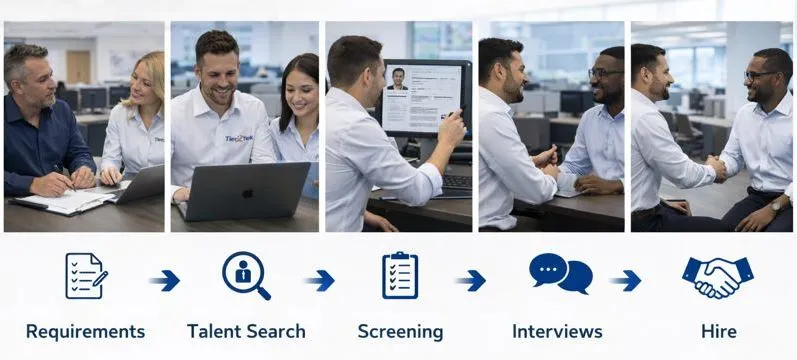
IT staffing agencies function as an extension of an employer’s hiring process, prioritizing accuracy, speed, and risk reduction.
| Step | Description |
|---|---|
| Define Requirements | Clarify technical needs, business objectives, and risk factors |
| Source Qualified Candidates | Identify professionals with verified experience |
| Evaluate Technical Skills | Review depth of knowledge and applied expertise |
| Screen for Industry Fit | Confirm alignment with environment and scale |
| Present Best Fit Candidates | Deliver candidates prepared for direct hire |
| Support the Direct Hire Process | Assist through offer and acceptance |
Common Mistakes Companies Make When Hiring IT Staffing
- Hiring for specific tools instead of system reliability and scalability
- Assuming senior titles guarantee leadership or accountability
- Underestimating documentation and knowledge transfer requirements
- Treating cybersecurity as a tool problem instead of a process risk
- Misjudging how IT roles affect business continuity during growth
Why Companies Use IT Staffing Agencies
Organizations rely on IT staffing agencies when hiring mistakes introduce operational and financial risk.
- Reduce exposure from miss hires in critical roles
- Access hard to find technical expertise
- Accelerate hiring timelines
- Offset internal recruiting capacity limits
- Improve long term retention outcomes
- Gain insight into market availability and compensation
- Support organizational growth with stable talent
IT Staffing Positions We Staff
Tier2Tek Staffing supports direct hire IT staffing across a broad range of technical, systems, and digital roles that directly impact reliability, scalability, and business continuity.
| Role | Key Skills or Tools | Typical Industries |
|---|---|---|
| IT Support Specialist | Ticketing systems, troubleshooting, end user support | Corporate IT, Healthcare |
| Desktop Support Technician | Windows, macOS, hardware support | Enterprise, Education |
| NOC Engineer | Monitoring tools, incident response | Telecommunications, MSPs |
| Systems Administrator | Windows, Linux, Active Directory | Finance, Healthcare |
| Network Engineer | Routing, switching, firewalls | Enterprise IT |
| Telecom Engineer | VoIP, PBX, network infrastructure | Telecom, Corporate IT |
| Cybersecurity Analyst | SIEM, threat detection, compliance | Finance, Government |
| Cloud Engineer | AWS, Azure, infrastructure design | Technology, Retail |
| Database Administrator | SQL, performance tuning, backups | Finance, Manufacturing |
| Data Scientist | Python, analytics, modeling | Technology, Research |
| IT Architect | Enterprise architecture, systems design | Large enterprises |
| Software Developer | Java, .NET, Python | SaaS, Product companies |
| ERP Analyst | SAP, Oracle, NetSuite | Manufacturing, Finance |
| Technical Writer | Documentation, SOPs, user guides | Technology, Healthcare |
| Change Management Lead | Process adoption, stakeholder alignment | Enterprise transformation |
| Business Analyst | Requirements gathering, data analysis | Professional Services |
| DevOps Engineer | CI/CD, automation, cloud pipelines | Software Development |
| Copywriter | Digital content, technical messaging | Technology, Marketing |
| UI UX Designer | User research, design systems | SaaS, Digital products |
| Instructional Designer | Training programs, LMS | Corporate training |
| ServiceNow Administrator | ITSM workflows, automation | Enterprise IT |
| Workday Analyst | HCM, integrations | Corporate HR systems |
| SharePoint Administrator | Collaboration platforms, governance | Enterprise IT |
| Machine Learning Engineer | Models, data pipelines, AI systems | Technology, Research |
Types of IT Professionals and What They Do
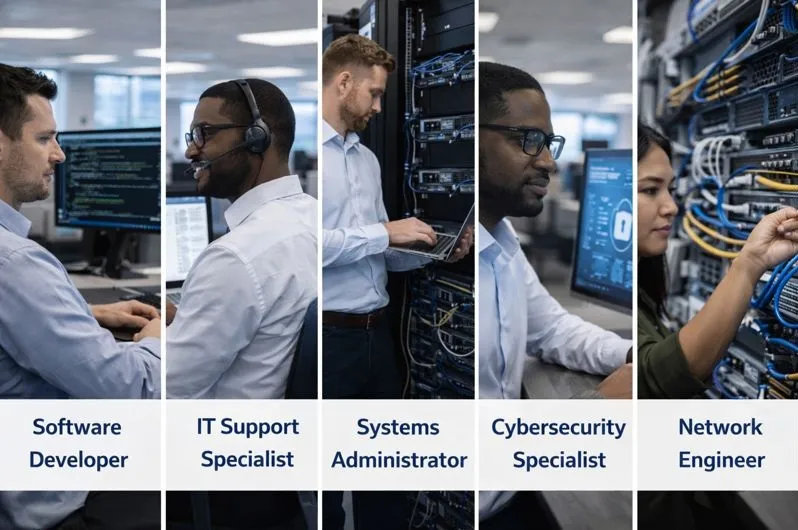
IT Support Professionals
Provide frontline technical assistance that keeps daily operations running. High performing IT support professionals reduce downtime through structured problem resolution rather than repeated fixes. Employers often underestimate how much this role affects productivity and user trust.
Desktop Support Technicians
Maintain end user hardware and operating systems. The difference between average and strong performers is documentation discipline and proactive issue prevention.
NOC Engineers
Monitor systems and networks to identify issues before outages occur. This role is frequently misunderstood as reactive, when it is central to uptime and service reliability.
Systems Administrators
Manage servers, operating systems, and identity platforms. Strong administrators design for stability and recovery, not just availability.
Network and Telecom Engineers
Design and maintain connectivity and voice infrastructure. Employers often overlook how telecom decisions affect scalability and long term cost.
Cybersecurity Professionals
Protect systems, data, and users from evolving threats. High performing professionals focus on risk reduction and response planning rather than tool management alone.
Cloud Engineers
Architect and manage cloud environments. Top performers balance performance, security, and cost control. A common misunderstanding is assuming cloud platforms automatically simplify operations.
Database Administrators
Ensure data availability, integrity, and performance. Employers often underestimate the business impact of poor database design and maintenance.
Data Scientists
Analyze complex datasets to inform business decisions. High performers translate insights into action, while average performers focus only on models.
IT Architects
Design enterprise systems that support long term business strategy. Their work is often misunderstood as theoretical, despite its direct impact on scalability and risk.
Software Developers
Build and maintain applications that support core operations. What separates strong developers is attention to maintainability and system integration.
ERP Professionals
Support enterprise platforms that manage finance, operations, and supply chain. Employers often underestimate the change management required for ERP success.
Technical Writers
Create documentation that enables consistency and knowledge transfer. This role is frequently undervalued despite its impact on onboarding and risk reduction.
Change Management Leaders
Guide organizations through technology driven change. Their responsibility is often misunderstood as communication only, rather than adoption and accountability.
Business Analysts
Translate business needs into technical requirements. Strong analysts prevent costly rework by identifying gaps early.
DevOps Engineers
Bridge development and operations through automation. High performers design systems that scale reliably rather than simply deploy faster.
Copywriters in IT Environments
Develop clear messaging for technical products and platforms. Employers often overlook how clarity affects adoption and usability.
UI UX Designers
Design user centered digital experiences. The difference between average and high performing designers is their ability to align usability with business outcomes.
Instructional Designers
Create structured learning programs for technology adoption. This role is often misunderstood as content creation rather than performance enablement.
ServiceNow Professionals
Configure and manage IT service workflows. Strong professionals design processes that scale across the organization.
Workday Professionals
Manage and optimize enterprise HR systems. Employers often underestimate integration complexity and data governance needs.
SharePoint Administrators
Oversee collaboration platforms and content governance. Their work directly impacts knowledge management and compliance.
Machine Learning Engineers
Build and deploy AI driven systems. High performers focus on data quality and model reliability, not just algorithm performance.
Industries We Serve
Tier2Tek supports IT staffing across a broad range of industries.
- Technology and Software
- Financial Services
- Healthcare
- Manufacturing
- Energy
- Government Contractors
- Professional Services
- Retail and E-commerce
- Logistics and Transportation
Tools, Technologies, or Skills Used in IT Staffing
Hiring decisions depend on understanding the environments candidates will manage.
| Tool or Skill | Primary Use |
|---|---|
| AWS | Cloud infrastructure |
| Azure | Enterprise cloud services |
| Linux | Server administration |
| Python | Automation and development |
| Java | Enterprise applications |
| SQL | Data management |
| Firewalls | Network security |
| CI/CD Pipelines | Deployment automation |
| ITIL | Service management |
Why Work With Tier2Tek for IT Recruitment
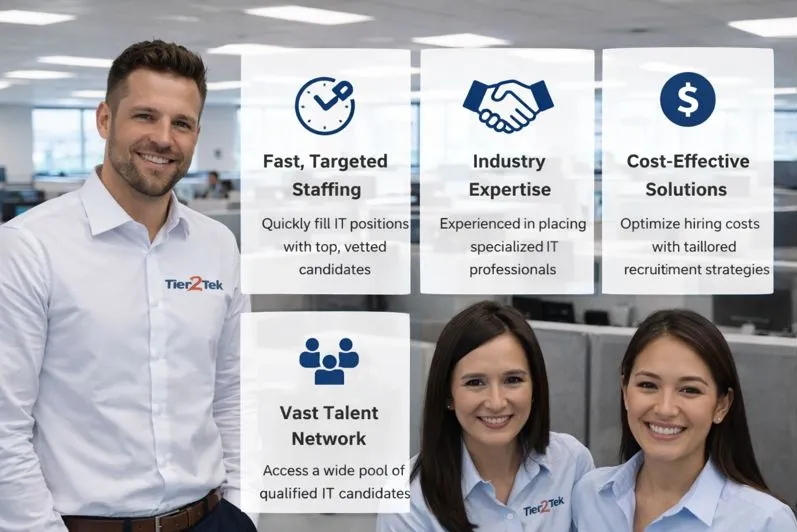
Tier2Tek Staffing aligns recruiting with business risk, reliability, and scale.
- Direct hire staffing only
- Qualified candidates delivered within 1 to 2 business days
- No payment until you hire
- Best in class staffing agency processes
- Industry focused recruiting expertise
- National staffing capability
- Consistent and transparent communication
Where We Provide IT Staffing
Tier2Tek provides national IT staffing services across the United States. We support on site, hybrid, and remote hiring models while maintaining consistent recruiting standards.
Our nationwide approach allows employers to scale their IT teams without sacrificing reliability or long term performance.
How We Recruit Your IT Talent
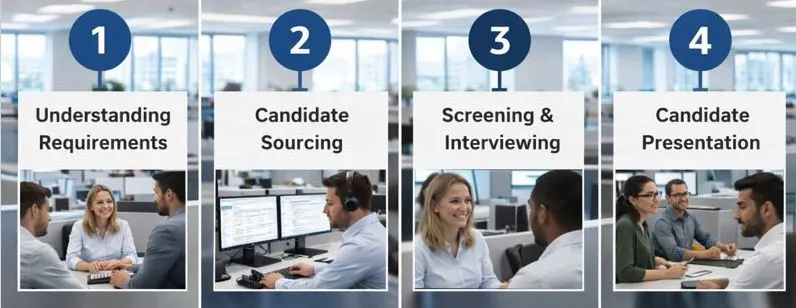
Our recruiting process emphasizes accuracy and long term fit.
- Understand Your Needs
- Source Candidates
- Screen for Fit
- Present Top Talent
Case Studies in IT Recruiting

SaaS Company
Challenge: Needed reliable IT support during rapid internal growth.
Solution: Targeted candidates with high-volume support experience.
Result: Improved response consistency and reduced ticket backlog.

Healthcare
Challenge: Database candidates lacked regulated environment experience.
Solution: Refined criteria to prioritize compliance and system ownership.
Result: Improved database stability and audit readiness.

Financial Services
Challenge: Software engineer hiring delayed by shifting requirements.
Solution: Maintained engagement while clarifying role expectations.
Result: Better long term fit and faster acceptance.
IT Staffing vs Related Staffing Services
IT staffing supports permanent, full time hiring rather than temporary coverage.
| IT Staffing | Related Staffing |
|---|---|
| Direct hire only | Often contract based |
| Long term employment focus | Short term engagement |
| Risk and retention driven | Speed driven |
| Stability oriented | Turnover accepted |
FAQs About IT Staffing
For most IT roles, Tier2Tek provides qualified candidates within 1 to 3 business days.
No. Tier2Tek provides direct hire staffing only.
No. You do not pay until you hire.
Tier2Tek supports hiring for entry-level through senior and leadership IT roles, depending on business needs, system complexity, and long-term growth plans.
Yes. Tier2Tek collaborates directly with HR, IT leadership, and hiring managers to ensure expectations, timelines, and responsibilities remain aligned.
Search criteria can be adjusted based on feedback, budget changes, or shifting technical priorities without restarting the process.
Tier2Tek manages sourcing and screening, allowing employers to focus primarily on final interviews and hiring decisions.
Special attention is given to candidate track record, including tenure history and progression, to avoid short term job hopping and support long term contribution, stability, and retention.
When IT Staffing Is Not the Right Hiring Solution
IT staffing may not be appropriate for exploratory roles, short term initiatives, or organizations without defined accountability and long term planning for technical ownership.
About Tier2tek IT Recruiting Expertise
Tier2Tek Staffing brings extensive experience recruiting IT, engineering, and professional talent for organizations operating at scale. Our recruiters understand how technical roles affect uptime, security, and long term growth.
By focusing exclusively on direct hire staffing, Tier2Tek aligns recruiting strategy with retention, performance, and risk management outcomes.
This content follows Tier2Tek Staffing’s internal publishing and review process. To learn more about how we create and update content, visit our Editorial Standards at https://tier2tek.com/about-us/editorial-standards/.
Get Started With Your IT Staffing Today
Reduce hiring risk and secure dependable IT talent with Tier2Tek Staffing.